Château de Seraing, Former prince-bishops' summer palace in Seraing, Belgium
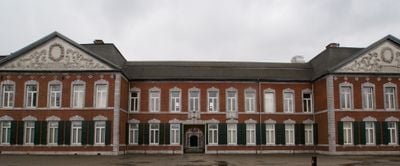
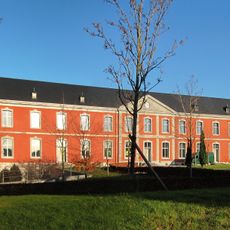
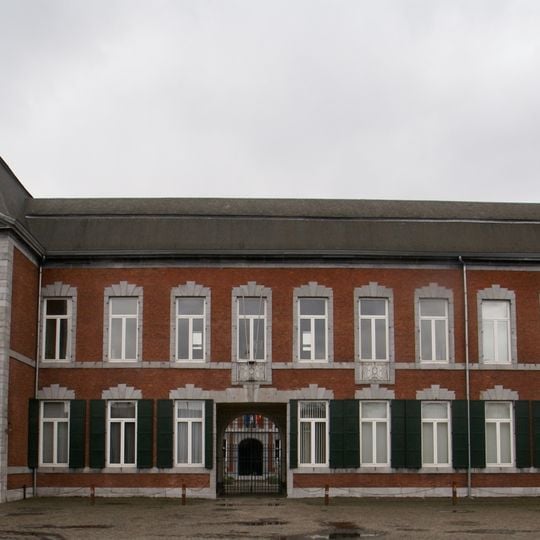
The Château de Seraing is a Mosan Baroque palace on the bank of the Meuse in Seraing, near Liège. Its main 18th-century building, by architects Jacques-Barthélemy Renoz and Etienne Fayen, has a red-brick facade with grey stone window surrounds, a stone band between the floors and an arched central gateway. The complex also includes a Baroque palace church and buildings around a cour d'honneur.
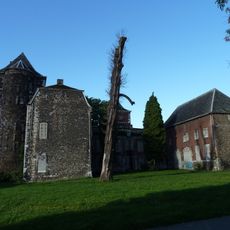
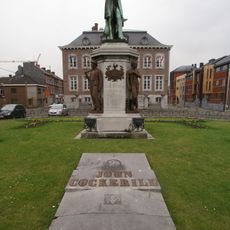
Seraing served as the summer residence of the prince-bishops of Liège, though the start date is unknown; some sources trace the castle to 1288. In the 17th century it grew into a palace with a classical wing facing the Meuse, a church and formal gardens. Around 1750 Prince-Bishop Jean-Théodore de Bavière had it rebuilt by architects Jacques-Barthélemy Renoz and Etienne Fayen. Nationalised in 1795, it later housed a military hospital and a gunpowder works before Willem I sold it in 1817 to James and John Cockerill.
The château's name recalls its double life: summer palace of the prince-bishops of Liège, then headquarters of the Cockerill steel firm. Its Mosan Baroque main building, 18th-century façades and roofs, and the surrounding cour d'honneur are listed Walloon heritage. The Baroque palace church beside it still holds religious services, and the administrative centre next to it opened in 2016.
The castle is private property today and not open to visitors, but the outer walls can be viewed from the neighboring streets. The best spots for photographing the exterior are from the publicly accessible paths around the grounds.
The Cockerill brothers bought the estate in 1817 and built Belgium's first coke-fired blast furnaces on its grounds; John Cockerill became sole owner in 1823. The former episcopal summer palace has housed Cockerill Maintenance & Ingénierie since 2002.
The community of curious travelers
AroundUs brings together thousands of curated places, local tips, and hidden gems, enriched daily by 93,458 contributors worldwide.