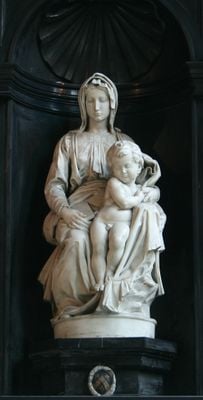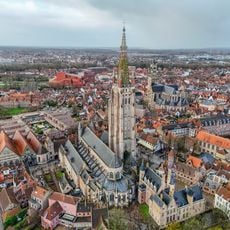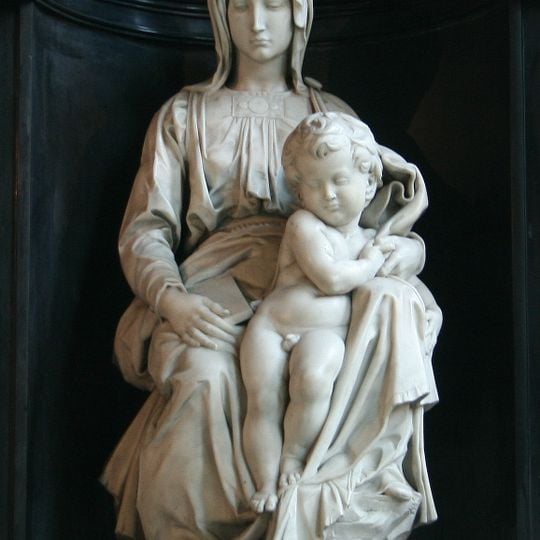
Madonna of Bruges, Marble statue in Church of Our Lady, Bruges, Belgium.
The Madonna of Bruges is a Carrara marble sculpture of the Virgin Mary and the Christ Child, carved from a single block and 128 cm tall. Mary sits frontally, a veil over her head and a square-necked bodice, her right hand resting on a closed book in her lap. The naked child stands at her right side, leaning against her leg and gripping a fold of her mantle with both hands.
Michelangelo carved the Madonna of Bruges between 1501 and 1504, about five years after finishing the Vatican Pietà. In 1504 the Bruges cloth merchants Giovanni and Alessandro Moscheroni (Mouscron) bought it for 100 ducats, and in 1514 they gave it to the Church of Our Lady. It was the first Michelangelo sculpture to leave Italy during his lifetime. French revolutionaries took it to Paris in 1794; it came back after Waterloo in 1815.
The way the figures are posed and their emotional expression look quite different from other religious sculptures made around the same time in Northern Europe. This Italian approach to showing human feeling in marble still stands out to visitors today.
The sculpture is protected behind bulletproof glass inside the Church of Our Lady, which charges an entrance fee. Visitors should check opening hours in advance, as they vary by season.
In 1944 retreating German soldiers took the sculpture away, wrapped in mattresses and loaded on a Red Cross truck. It was found the next year in a salt mine at Altaussee, Austria, and returned to the church. The episode features in the 2014 film The Monuments Men.
The community of curious travelers
AroundUs brings together thousands of curated places, local tips, and hidden gems, enriched daily by 94,578 contributors worldwide.