Kortenberg Abbey, Benedictine monastery in Kortenberg, Belgium
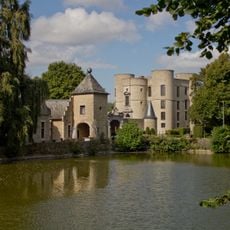
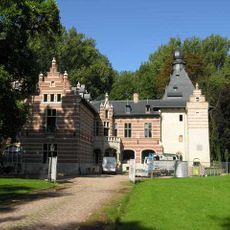
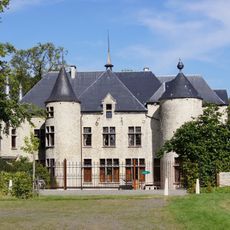
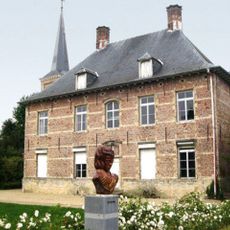
Kortenberg Abbey is a former Benedictine nunnery whose surviving buildings date from the 17th and 18th centuries. The gatehouse retains its early 17th-century Gothic pointed arch, the Veehof farmyard dates from 1650, and the Bouwerij farm from 1732. The main building, shown in the photograph, is a long brick range with a steep dark roof, six dormer windows, a central round-arched entrance with a fanlight, and a balustraded stone terrace.
The community was founded before 1105, traditionally dated 1095, when a devout woman named Duva gathered clerics around a church on the Curtenbergh hill; Walcher, Bishop of Cambrai, confirmed the altar donation in 1095 and Odo of Tournai confirmed the foundation in 1110. Around 1210 the community left the hill for the valley at Minneveld, and around 1223 it adopted the Rule of Benedict, the year it obtained a bull from Pope Gregory IX. In 1312 Duke John II of Brabant signed the Charter of Kortenberg in the abbey, where the council created to enforce it met until 1375.
The Charter of Kortenberg, signed at the abbey in 1312 by John II Duke of Brabant, established constitutional rights for citizens of the duchy.
The monastery now functions as a diocesan retreat center and is reachable by the Brussels-Liège train line. Its proximity to Kortenberg station and the A3/E40 highway makes access straightforward.
In 1129 Bishop Burchard of Cambrai granted the monastery control over several parishes in the region, significantly expanding its influence. These parish rights and their associated tithe revenues provided economic security for centuries.
The community of curious travelers
AroundUs brings together thousands of curated places, local tips, and hidden gems, enriched daily by 93,935 contributors worldwide.