Bourlaschouwburg, Neoclassical theatre in the Theaterbuurt, Antwerp, Belgium
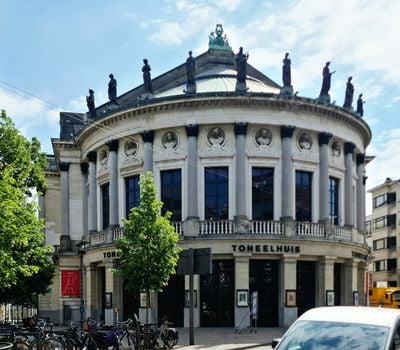
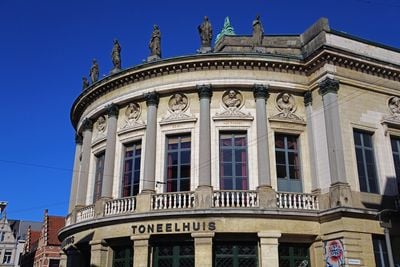
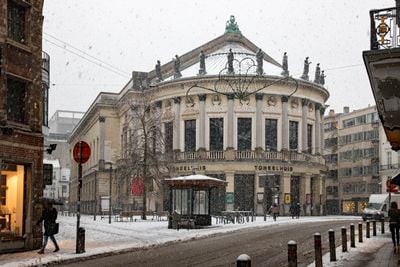
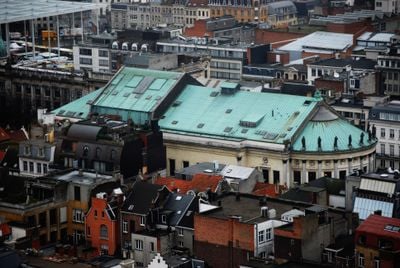
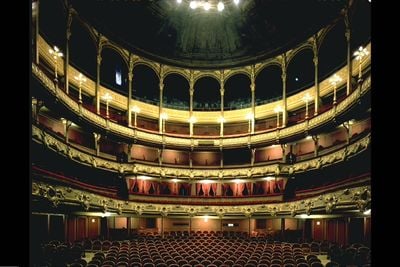
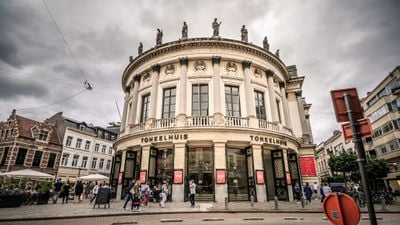
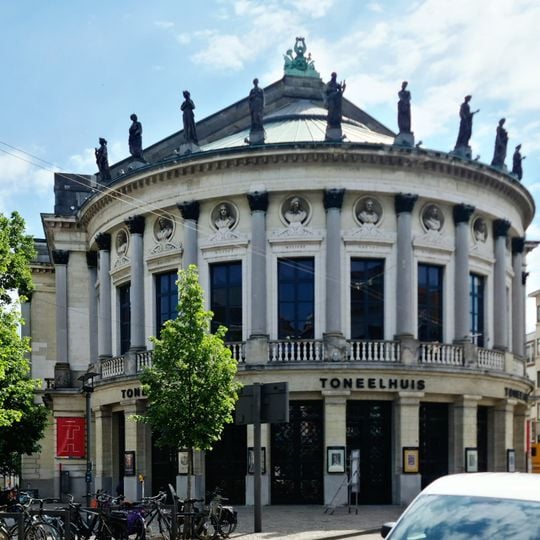
The Bourlaschouwburg is a neoclassical theatre on the site of the former Tapissierspand tapestry market in Antwerp. Its pale grey stone facade has a rounded central section with a row of dark statues along the roofline, a frieze of circular medallions framing heads between tall columns, large rectangular windows with dark glass above a stone balustrade, and rusticated ground-level stone with arched doorways. Above the main entrance, dark letters spell "TONEELHUIS". The auditorium seats around 900.
The city commissioned city architect Pierre Bruno Bourla to design the theatre in 1827; construction began in 1829 but was delayed by the Belgian Revolution. It was completed in 1834 and opened on 1 September as the Grand Théâtre or Théâtre Royal Français. The interior was enlarged in 1865, raising capacity from 1,300 to 2,000 seats, with further works in 1904 and 1913. In 1933 the name changed to Koninklijke Nederlandse Schouwburg, and the building became a protected monument on 25 March 1938.
The theatre is named after city architect Pierre Bruno Bourla, who designed it in 1827. From 1834 to 1933 the resident company was the French-speaking Théâtre Royal Français, called "de Franse Opera"; in 1933 the Koninklijke Nederlandse Schouwburg took over the stage. Since 1994 it has housed Het Toneelhuis, formed by the merger of the KNS and the Blauwe Maandag Compagnie.
The theatre stands in Antwerp's Theaterbuurt, on the site of the former Tapissierspand tapestry market, a short walk from the city centre. The entrance is through the rusticated ground level with its arched doorways, beneath the "TONEELHUIS" lettering. The auditorium seats around 900, so book ahead for performances; the building is a protected monument, so access outside show times is limited.
The theatre preserves its complete stage system from the 1830s with all original machinery and rigging built by French craftspeople. This working system is unique in Europe and still allows today for recreation of 19th-century stage techniques.
The community of curious travelers
AroundUs brings together thousands of curated places, local tips, and hidden gems, enriched daily by 94,433 contributors worldwide.