Onze-Lieve-Vrouwekerk, Gothic church in Deinze, Belgium
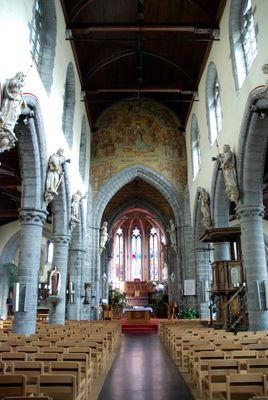
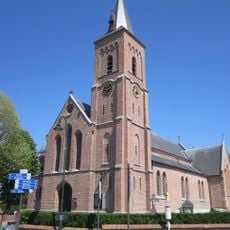
The Onze-Lieve-Vrouwekerk is a Scheldt Gothic church built largely of Tournai stone, with a basilican plan, a square Romanesque base carrying an octagonal crossing tower, and a five-sided choir. The west facade has two octagonal stair turrets and a pointed portal with a 1889 stone statue of the Virgin. Inside, cylindrical columns with carved capitals line the nave, and a 1740 Van Peteghem organ stands in a Petrus Meyns case.
A church in Deinze is first documented in 840, when Louis the Pious donated it to the Bishop of Tournai. After a fire in 1327 it was rebuilt in Scheldt Gothic style; city fires in 1381 and 1382 destroyed the choir, which was rebuilt and enlarged. King Philip IV authorised a donation in 1637 for restoring the nave, consecrated by Bishop Triest in 1643. Architect Auguste Van Assche led a thorough restoration from 1862 to 1906.
The square beside the church was named Sint-Poppoplein on 13 May 2011, after Poppo, the abbot of Stavelot born in Deinze in 978 who gave relics to the church after returning from the Holy Land. Those relics were walled into the church. In the left aisle hangs an Adoration of the Magi attributed to Gaspar de Crayer, though some now give it to Simon De Pape of Oudenaarde.
The church sits on the Market Square in the center of Deinze and is open regularly throughout the week for visitors. Its central location makes it easy to reach on foot and it serves as a natural meeting point in the town.
In 1988 a 37-bell carillon was installed here, cast by the Eijsbouts foundry; eleven more bells followed in 1994. It is described as the first large-tower carillon ever installed. A computer plays a melody every half hour, and a carillonneur performs regularly. Four separate ringing bells hang alongside it, one dating from 1652.
The community of curious travelers
AroundUs brings together thousands of curated places, local tips, and hidden gems, enriched daily by 94,093 contributors worldwide.