Jan van Eyckplein, Square in Brugge, Belgium
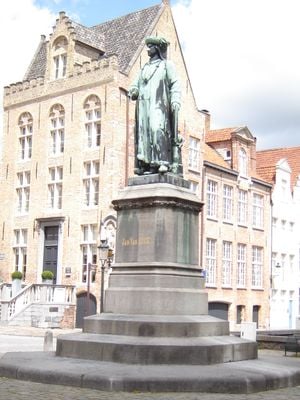
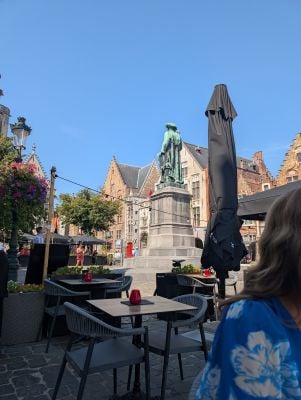
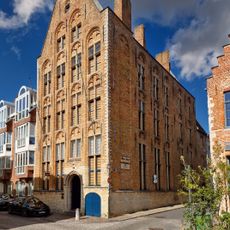
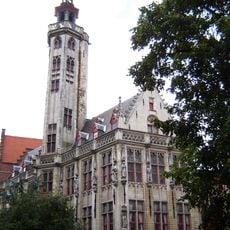
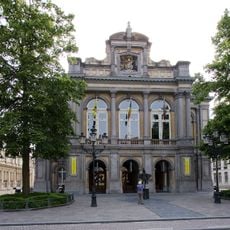
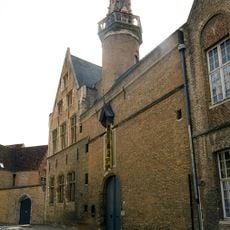
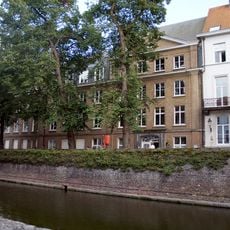
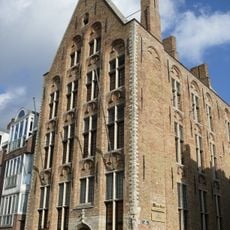
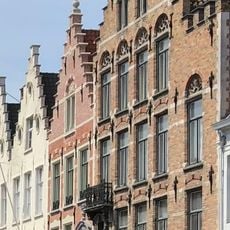
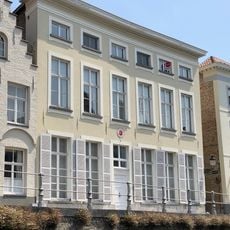
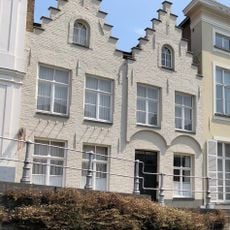
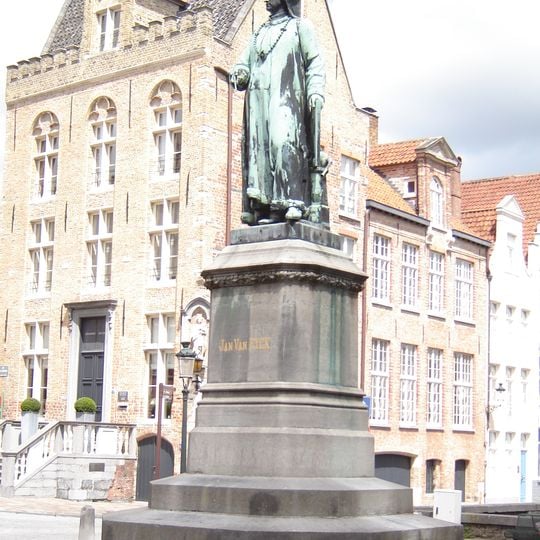
Jan van Eyckplein is a roughly rectangular stone-paved square at the head of the Spiegelrei, about 15 m wide and 40 m long. In its centre stands a bronze figure of Jan van Eyck in long robes and a chain collar, a small object raised in his right hand and a sword or staff in his left, on a tall grey stone pedestal with a stepped base and moulded cap; gold letters on the shaft read "JAN VAN EYCK". Brick houses with stepped gables, the Poortersloge and the Tolhuis frame the square.
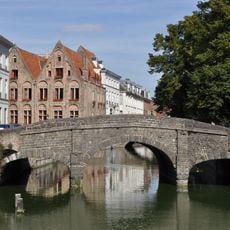
The square occupies the site of the Sint-Jansbrug, also called Nieuwjaarsbrug, a bridge first mentioned in 1282 and rebuilt in white Brabant stone in 1389 and as a three-arch bridge in 1444. In 1787 the bridge was demolished and part of the Kraanrei covered, creating the square. It was named after Jan van Eyck in 1844; his marble statue of 1856 was replaced in 1878 by the current one on a high bluestone pedestal.
The square's name honours Jan van Eyck, court painter to Philip the Good, who settled his workshop in Bruges around 1430. In the Middle Ages this was the port quarter where tolls were levied at St John's Bridge and a commission taken on each transaction at the Toll House. Until the First World War Bruges residents called it Petattenmarkt, after the weekly potato market held here.
The square lies at the junction of Academiestraat, Spiegelrei and Spanjaardstraat, with bus stop 502114 Brugge Jan Van Eyckplein nearby and the Langestraat car park a short walk away. The paving, kerbs and old-style bollards and lanterns date from the 1986 redevelopment, so the surface is flat and even. A VR viewer on the waterfront shows the 15th-century port quarter as it once looked.
The square's name changed repeatedly: it kept the name Sint-Jansbrug after 1787, became Academieplaetse in the French period after the drawing and painting academy in the Poortersloge, and was only named Jan van Eyckplaats in 1844. The first statue, a marble work by Jan-Robert Calloigne unveiled in 1856, was removed in 1871 and stood on the Burg for a century. The present figure, designed by Hendrik Pickery, was inaugurated in 1878.
The community of curious travelers
AroundUs brings together thousands of curated places, local tips, and hidden gems, enriched daily by 94,553 contributors worldwide.