Sint-Annakerk, Baroque church in Bruges, Belgium
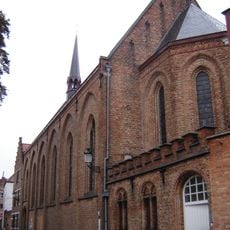
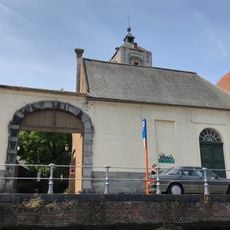
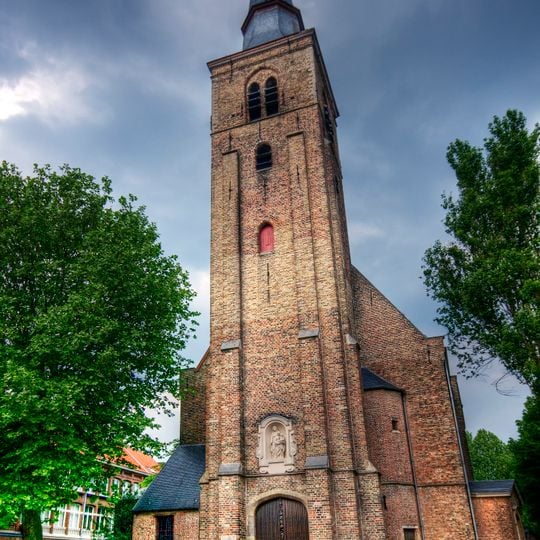
Sint-Annakerk is a single-nave brick church in the Sint-Anna district of Bruges, its tall reddish-brown tower topped by a dark slate spire with two tall louvered arched openings. Lower on the front face are a small arched window with a red shutter and a pale stone relief panel in a shallow niche above the arched wooden door. The tower adjoins a lower brick body with slate roofs.
A manor house, Hof ter Vere, was bought in 1496 and turned into a single-nave chapel consecrated in 1497; it was enlarged in 1506-1507 and became a three-nave church in 1516. After the iconoclasm it was sold in 1580 and partly demolished. A new church rose on the rubble from 1611, was consecrated in 1621, and was rebuilt from late Gothic into Baroque form at the end of the 17th century.
The church is dedicated to Saint Anne, mother of Mary, and owes its nickname "salon church of Bruges" to the rich fittings paid for by generous donors. A Gothic door at the back left opens onto the armendis, or dismeestersbank, of 1688, where the poor of the Sint-Anna district collected goods or coins on fixed days; they kept coming until the First World War.
The church stands on Sint-Annaplein in the Sint-Anna district, northwest of the Bruges centre. The Gothic door at the left rear leads to the armendis, the alms board bench of 1688 where the poor of this district, one of the poorest in Bruges, collected goods or coins on fixed days until the First World War. Look for the shell-shaped baptismal font with its copper lid of 1630.
The shell-shaped baptismal font has a copper lid dated 1630. Guido Gezelle was baptised at this font on 1 May 1830, made his first communion in the church and, after ordination, celebrated his first Mass here.
The community of curious travelers
AroundUs brings together thousands of curated places, local tips, and hidden gems, enriched daily by 93,434 contributors worldwide.