Engels Klooster, Protected monastery in Bruges, Belgium.
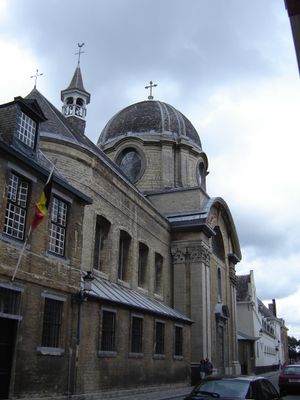
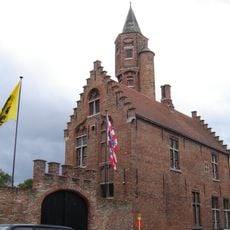
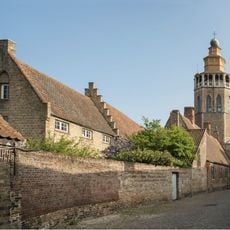
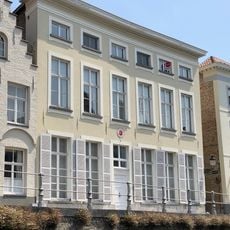
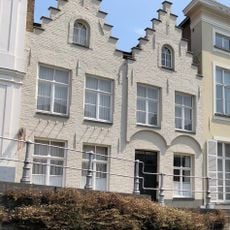
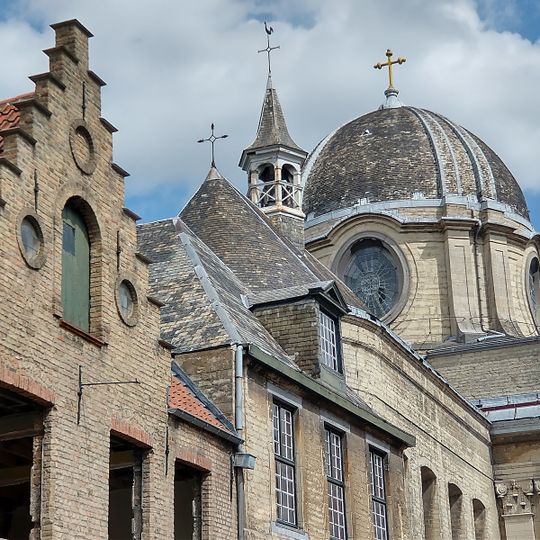
Engels Klooster is a monastery on Carmersstraat in Bruges, built around a late-Baroque domed church designed by Hendrik Pulinx and erected between 1736 and 1739. The brick complex joins a lower wing with slate roofs and a corner turret under a small onion cupola to the tall round drum with oval windows, ribbed dome and cross, beside a tower-like facade with a rounded arch.
English nuns founded this monastery in 1629 as a refuge during Catholic persecution in England. After fleeing to Britain during political unrest, the community returned to Bruges in the early 1800s.
The name "Engels Klooster" dates from 1802, when locals gave it spontaneously after the sisters returned from England. The community ran a boarding school for English-speaking girls, later a finishing school for Belgian noble families; since 1973 the former school has served as the Nazareth guesthouse.
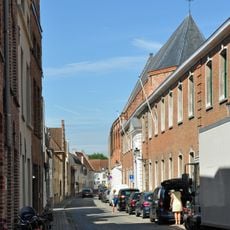
The monastery stands on Carmersstraat, its street front closed by a classicist gateway whose entrance was walled up in 1802; above it sits a broken pediment crowned by a statue niche. The domed church, built 1736-1739 to a design by Hendrik Pulinx, is a single nave in late Baroque or early Classicist style, its dome resting on pendentives pierced by oval windows on four sides. The community is cloistered, so visits are not a matter of simply walking in.
The convent's most prized possession is a portrait of Thomas More from the school of Hans Holbein, brought back from England in 1802 together with a vertebra from More's neck, both kept as relics. The community was led into exile in 1794 by prioress Mary Augustina More, a descendant of Thomas More.
The community of curious travelers
AroundUs brings together thousands of curated places, local tips, and hidden gems, enriched daily by 93,617 contributors worldwide.