Dieweg Cemetery, Protected heritage cemetery in Uccle, Belgium.
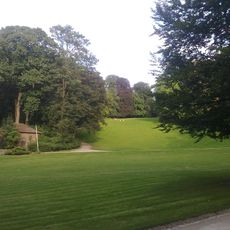
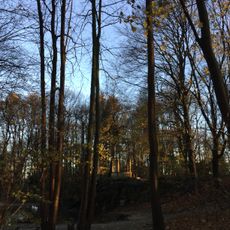
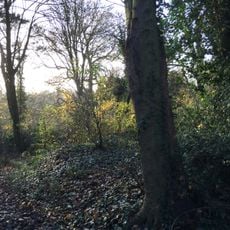
Dieweg Cemetery is a former burial ground on a sloping site along the old Dieweg in Uccle, on the northern flank of the Geleytsbeek valley, facing the Sonian Forest. Its paths and graves are overgrown, with funerary ironwork, medallions and broken slabs emerging from the vegetation. Monuments in neo-Gothic, neoclassical and Art Nouveau styles include the Stern tomb by Victor Horta.
Dieweg Cemetery opened in 1866 during a cholera epidemic, on a slope above the Geleytsbeek valley. It filled quickly as Brussels grew and the Saint-Job (1871) and Saint-Pierre (1876) cemeteries closed, and was enlarged in 1902, 1906 and 1923. Burials became rare after Verrewinkel Cemetery opened in 1945, and it was decommissioned in 1958.
Hergé, creator of Tintin, was buried here in 1983 by special exception, as was violinist Philippe Hirshhorn, winner of the 1967 Queen Elisabeth Competition, at Queen Fabiola's request in 1996. The graves of architect Paul Hankar and cartoonist Hergé draw visitors, while the adjacent Jewish section holds epitaphs from about fifteen countries.
Visitors should wear sturdy shoes as the terrain is uneven and pathways between graves may be overgrown. It is best to explore on foot and allow time to wander through different sections of the grounds.
The grounds host more than 200 plant species growing among the graves and between monuments. This biodiversity makes the location a place where history and nature intertwine.
The community of curious travelers
AroundUs brings together thousands of curated places, local tips, and hidden gems, enriched daily by 93,996 contributors worldwide.