Sint-Julianuskerk, church in Belgium
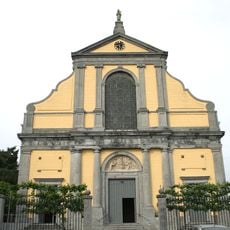
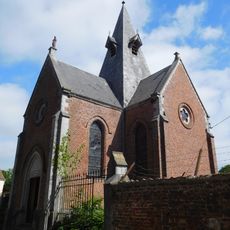
Sint-Julianuskerk is a church in Ath whose Gothic tower, square in grey stone with a crenellated parapet and a black clock face with gold Roman numerals, survives from the medieval building. After the 1817 fire the nave was rebuilt in austere neoclassical style, its interior lined with Corinthian-inspired columns; the red-brick apse with stone buttresses and the entrance portal were kept.
A church dedicated to Saint Julian of Brioude stood in Vieux Ath from 1076. It was moved inside the town walls from 1394 onto land partly given by alderman Jacques de Séjournet; work began in 1395, worship opened in 1404, and consecration took place on 7 July 1415. The tower was finished in 1462 and a spire over 90 metres tall in 1464. Lightning struck in 1612, 1705 and 1791, and a storm damaged the church in 1799. The spire burned on 10 April 1817; only the tower, portal, chevet and the 16th-century Chapelle de la Bonne Mort survived. Rebuilt 1819–1822 in neoclassical style to plans by silversmith and sculptor Gabriel Florent, the tower was restored 1846–1854 by architects Aimable Désiré Limbourg and Jean-Baptiste Mottrie, without the spire. A 1951 fire brought down the vaults; the church reopened for the Ducasse d'Ath in 1953.
The church is the main Catholic parish of Ath, and its name recalls Saint Julian of Brioude, to whom a church in nearby Vieux Ath was dedicated as early as 1076. A carillon is documented from 1481; destroyed in 1817, it was rebuilt and inaugurated on 23 August 1953, and now has 49 bells. Carillon concerts are held each summer, and the Ath music academy has taught carillonneurs since 1994.
The church stands in the heart of Ath, a short walk from the Grand-Place. The preserved medieval tower, entrance portal and choir walls are the oldest parts to look for; the 1817 fire spared them. The carillon of 49 bells is played in summer concerts, and carillon lessons have been taught at Ath's music academy since 1994.
The carillon is first documented in 1481, when a player named Jean Godefroid performed on it; by 1520 it had about a dozen bells. Destroyed in the 1817 fire, it was rebuilt and inaugurated on 23 August 1953, and now numbers 49 bells after additions in 1981 and 2000. One bell survives from 1714, cast by G. Witlock.
The community of curious travelers
AroundUs brings together thousands of curated places, local tips, and hidden gems, enriched daily by 95,543 contributors worldwide.