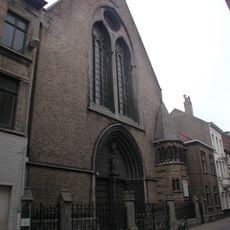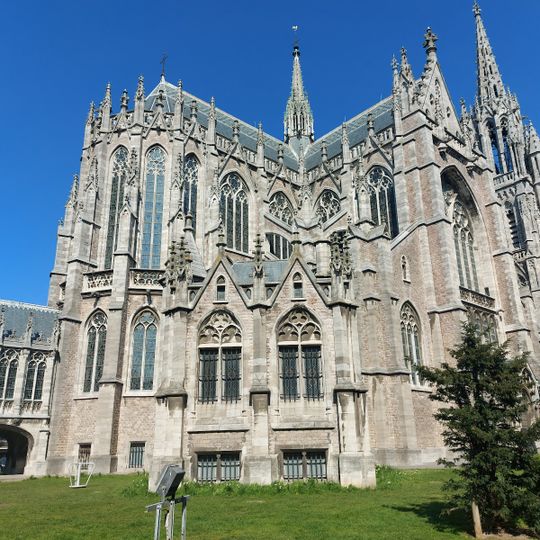
Sint-Petrus-en-Pauluskerk, Neo-Gothic church in Ostend, Belgium.
Sint-Petrus-en-Pauluskerk is a Neo-Gothic church built between 1899 and 1905 to plans by Louis Delacenserie, who modelled it on Cologne Cathedral and Vienna's Votivkirche. Its light grey and beige limestone facade has two 72-metre spires flanking a rose window and three arched entrances, with statues of Saint Peter, the Virgin Mary and Saint Paul in the lower niches. The church is 70 metres long and 36 metres wide.
The predecessor Sint-Pieterskerk burned down on 14 August 1896; only its tower, the Peperbusse, survived behind the present church. King Leopold II backed the new building, and Bruges city architect Louis Delacenserie accepted the commission under royal pressure. Construction began on 18 April 1899, the shell was finished in October 1904, and the church was inaugurated on 4 September 1905 in Leopold II's presence. Bishop Waffelaert consecrated it on 31 August 1908.
The stained-glass windows along the left wall of the altar show every Belgian king and Queen Louise-Marie, though Albert II and Philippe are still missing; Baudelaire's window shows the young king wearing glasses. Other windows depict Saints Peter and Paul, the 1601–1604 Siege of Ostend, and Saint Martin. The neo-Gothic furniture was made by craftsmen from Antwerp and Bruges.
The church is centrally located and easy to find at Sint-Pietersstraat in Ostend. Visitors should plan their visit around typical opening hours and remember that it remains an active place of worship.
Behind the church, a hexagonal neo-Gothic chapel 28 m high holds the white Carrara marble tomb of Queen Louise-Marie, who died in Ostend on 11 October 1850. Sculptor Charles Auguste Fraikin carved it; a bronze crown tops the openwork pinnacle, and four niches in the buttresses hold statues of holy queens by Jan Baptist Van Wint.
The community of curious travelers
AroundUs brings together thousands of curated places, local tips, and hidden gems, enriched daily by 94,220 contributors worldwide.