Sint-Pieterstoren, Gothic bell tower in Ostend, Belgium
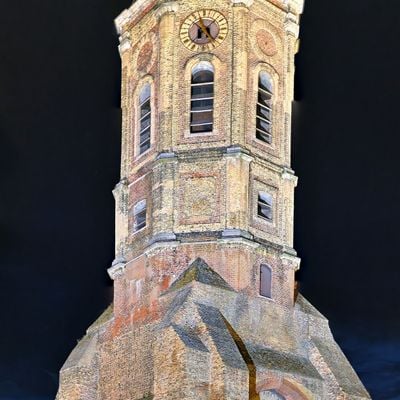
Sint-Pieterstoren is a freestanding bell tower in Ostend, the sole remnant of the old Sint-Pieterskerk. Its heavy square brick base dates from 1478, while the octagonal upper storey was completed in 1729. The tower has a large pointed-arch opening at its front, tall narrow louvred windows in the belfry, and a round clock face with gold hands and numerals near the top. A small cross sits at the roof peak.
Construction began in 1478, and the tower remains the sole surviving structure from the original Sint-Pieterskerk after the church burned down in 1896. The building endured the destruction that consumed the rest of the church and has stood as a monument ever since.
Locals call the tower Peperbusse, after an old-fashioned pepper mill whose shape it resembles; the nickname "De Blok" refers to its square lower body. Neighbours long said "d'ofgebrande kerke" (the burnt-out church) after the 1896 fire. Tourist brochures spread Peperbusse, and the name stuck once the art circle and gallery De Peperbusse was founded.
The tower opens regularly for public visits and allows you to explore its interior spaces and learn about how it changed over time. Wear sturdy shoes if you plan to climb the stairs, and check opening times before your visit.
The hermit who entered the tower on 8 February 1484 died there three years later, in 1487. The tower's other nickname, "De Blok", refers to its massive lower section, which resembles a block of houses. Locals long called the ruin "d'ofgebrande kerke" — the burnt-down church — after the 1896 fire.
The community of curious travelers
AroundUs brings together thousands of curated places, local tips, and hidden gems, enriched daily by 95,305 contributors worldwide.