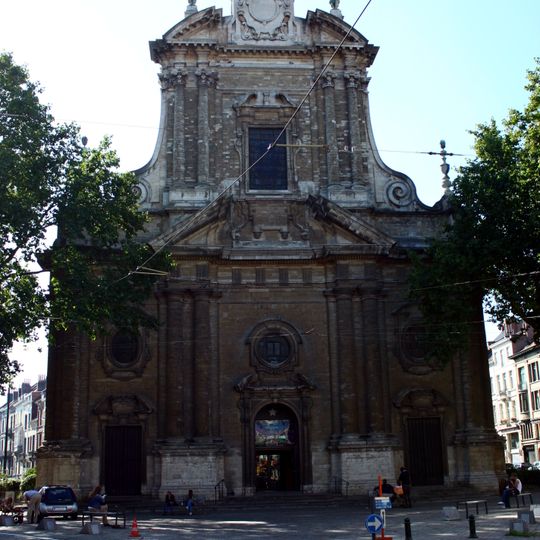
Church of the Holy Trinity, Catholic parish church in Ixelles, Brussels, Belgium
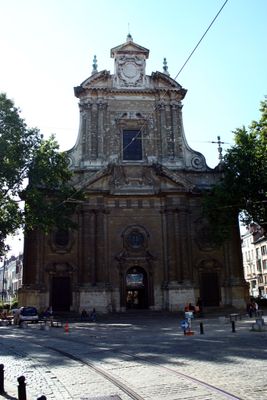
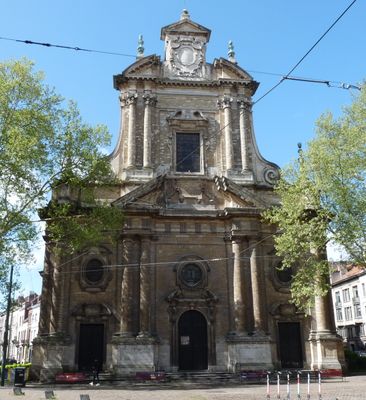
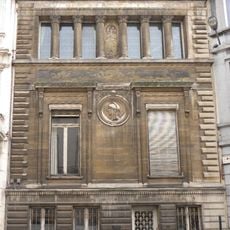
The Church of the Holy Trinity is a Catholic parish church in Ixelles, Brussels, whose facade is the 17th-century front of the former Augustinian church of Place de Brouckère, moved here stone by stone in 1893. The Grimbergen stone facade rises in three tiers with paired Doric columns, three doorways under broken pediments and oculi, and a curved gable topped by a small edicule and bell tower. Behind it, the 1895 nave of five bays leads to a transept and chapels added in 1907.
In the 19th century, as Avenue Louise was laid out, Leopold I pushed the urbanisation of Ixelles's Ten Bosch district; a temporary chapel was built there between 1847 and 1857 on land given by the banker Georges Brugmann, who also helped fund it. In 1893 the parish acquired the Baroque facade of the Augustinian church on Place de Brouckère, then being demolished, and rebuilt it stone by stone facing the new Rue du Bailli. Jules-Jacques Van Ysendyck took over in 1894, the nave opened in 1895, and the completed church, with transepts and chapels added by Symons in 1907, was opened for worship on 28 November 1908.
The congregation brings together people from over 40 nations, creating a space where diverse languages and traditions meet. Visitors experience a community that expresses itself through services in English and French, reflecting the neighborhood's international character.
The church stands at the corner of Rue du Bailli in Ixelles, a short walk from the Bailli tram stop and the Avenue Louise axis. The Baroque portal faces the street directly, so the facade is best seen from the opposite pavement. The nave, choir and transepts are open during services; the 1907 side chapels flank the crossing.
The Baroque facade was moved stone by stone in 1893 from the Augustinian church demolished for Place de Brouckère, and rebuilt facing the new Rue du Bailli. Architect Jacques Francart II, who spent part of his childhood in Italy, combined Italian Baroque with Brabant verticality; the Grimbergen stone front has three registers, paired Doric columns and broken pediments.
The community of curious travelers
AroundUs brings together thousands of curated places, local tips, and hidden gems, enriched daily by 94,932 contributors worldwide.