Africa Palace, Neoclassical palace in Tervuren, Belgium
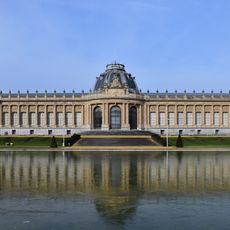
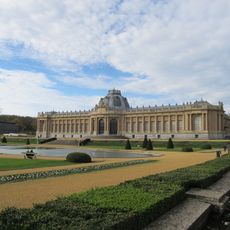
Africa Palace is a neoclassical building at the end of Avenue des Palais in Tervuren, 400 metres west of the Royal Museum for Central Africa. Its seven-bay central wing has a projecting portico with colossal Ionic columns and a triangular pediment, flanked by two square three-bay side wings. The facades combine blue and white stone, and a staircase lined with Egyptian sphinxes leads to a paved esplanade.
The Palace of the Colonies was built in 1897 by order of King Leopold II to plans by Alfred-Philibert Aldrophe, on the site of the former pavilion of William of Orange, which had burned in 1879. It hosted the colonial section of the 1897 International Exposition, with four sections of ethnographic objects, stuffed animals and Congolese export products. Its success led to the permanent Museum of the Congo in 1898; the museum moved to Charles Girault's larger building in 1910, and the palace was renamed Africa Palace in 2018.
The palace's main hall, the Hall of the Great Cultures, held a wooden Art Nouveau structure by decorator Georges Hobé, built from Bilinga wood to evoke a Congolese forest. The 1897 colonial exhibition here displayed ethnographic objects, stuffed animals and Congolese exports such as coffee, cacao and tobacco. In the gardens designed by Élie Lainé, 60 Congolese people were housed in a mock African village for the exhibition's duration; seven died.
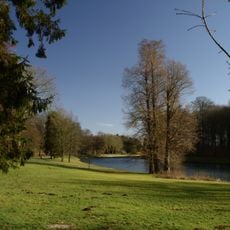
The palace stands at the end of the Avenue de Tervueren and the Avenue des Palais, about 400 metres west of the AfricaMuseum, of which it is a dependency. It is not a museum: it holds offices, storage rooms, classrooms and a reception hall, so there is no exhibition circuit to visit. Visitors approach it on foot through the Tervueren park; the sphinx-lined staircase and paved esplanade in front are outdoors.
The palace stands on the site of an earlier pavilion built by William of Orange. Leopold II's sister Charlotte of Belgium, widow of Emperor Maximilian of Mexico, lived there until it burned down in 1879. The Africa Palace was built in its place for the 1897 exposition.
The community of curious travelers
AroundUs brings together thousands of curated places, local tips, and hidden gems, enriched daily by 94,068 contributors worldwide.