Grote Markt, Medieval market square in Lier, Belgium.
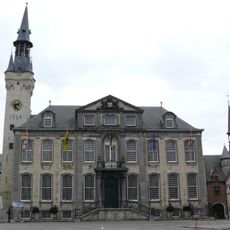
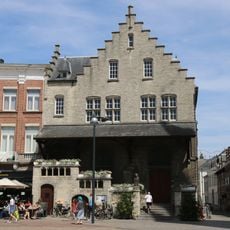
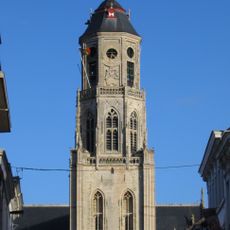
Grote Markt is a triangular square in Lier, paved with cobblestones since 1557. Its west side keeps 17th- and 18th-century guild houses, while the town hall and the square belfry with a clock face and the digits 1369 stand beside a pale stone building with a curved double staircase and three projecting flags.
Lier received its city charter in 1212, and the triangular Grote Markt has been its centre since the Middle Ages, with main streets converging from the city gates. A cloth hall, later the town hall, was built in 1367; the square in front was paved in 1383 and the whole square raised and cobbled in 1557. Three-quarters of the surrounding houses were destroyed in 1914, mainly on the western side surviving.
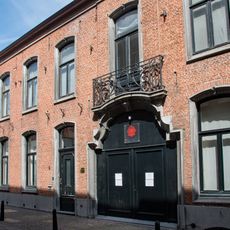
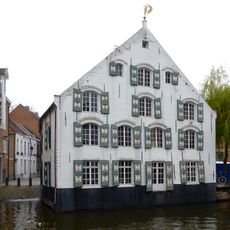
The square's name comes from its use as a market since the Middle Ages. A tile set into the paving, the heksensteen, marks where Cathelyne van den Bulcke was executed in 1590, the last witch burning in Lier; executions continued here until 11 May 1842, when the murderer of pastor Petrus De Groof was beheaded. Facades recall guilds: the Brouwershuis (no. 20, 1717) carries brewers' tools and Saint Arnold, and no. 38, built in 1908 for the Van In printing family, has a balcony on consoles showing Saint Augustine, Gutenberg and Dirk Martens.
The square lies in the town centre, where several main streets from the old town gates meet. It was repaved in 2011 and reopened on 27 April 2012, with five fountains by architects Robbrecht & Daem. Look for the tile in the paving that marks the site of the last witch burning, in 1590.
The south-west corner of the town hall serves as the gnomon for one of Adolphe Quetelet's meridians, a line set into the square for his astronomical work. Quetelet, born in Ghent in 1796, was the statistician and astronomer who founded the observatory in Brussels.
The community of curious travelers
AroundUs brings together thousands of curated places, local tips, and hidden gems, enriched daily by 93,565 contributors worldwide.