Bernissart fossil site, Paleontological site in Bernissart, Belgium
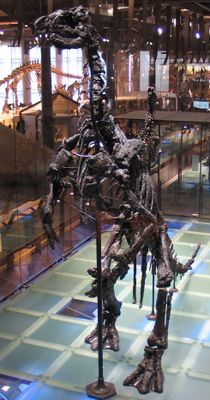
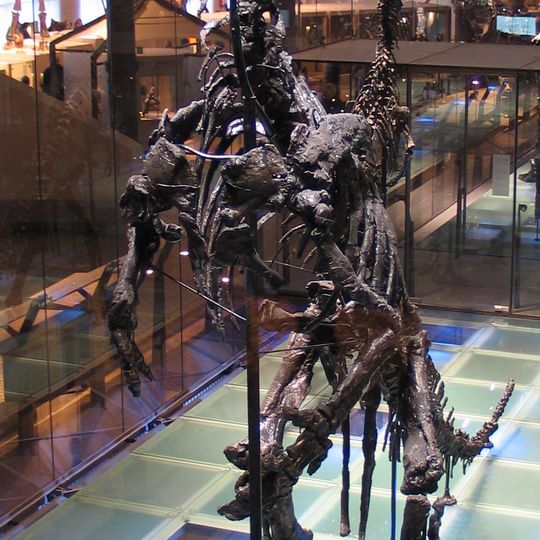
The Bernissart fossil site is a paleontological locality in the Sainte-Barbe coal mine at Bernissart, Belgium. Its fill, the Cran aux Iguanodons, yielded at least 43 Iguanodon bernissartensis specimens: 25 nearly complete skeletons and 18 partial ones, about 126–125 million years old. The mounted skeleton shows a long curved vertebral column, a large ribcage, a skull at the upper left, two robust hind legs with broad feet on a light tiled floor, and two shorter clawed forelimbs, with metal support rods and wires against dark-framed glass panes.
On 28 February 1878, miners Jules Cretteur and Alphonse Blanchard broke into a clay-filled sinkhole, the Cran aux Iguanodons, 322 metres down in shaft 3 of the Sainte-Barbe coal mine. They took the black bones for petrified wood until mine doctor Lhoir identified them as fossils. Louis Dollo later described 25 nearly complete skeletons of Iguanodon bernissartensis.
The mine's spoil was dumped and sorted at the surface, and the bones reached Brussels through the geologist François-Léopold Cornet, to whom the mine sent Léon Latinis on 7 April 1878. Louis Dollo later described Iguanodon bernissartensis from the material. The mine's own name, Sainte-Barbe, is still attached to the clay formation that holds the fossils.
The mine itself is not accessible to visitors today, as it became flooded and the site lies underwater. The excavated skeletons and bones can instead be viewed at the museum in Brussels, where they are on permanent display.
What stands out about this discovery is that so many complete skeletons were found in one location, raising questions about how and why these animals all died at the same time. Scientists continue to work on solving the mystery of this unusual clustering.
The community of curious travelers
AroundUs brings together thousands of curated places, local tips, and hidden gems, enriched daily by 95,041 contributors worldwide.