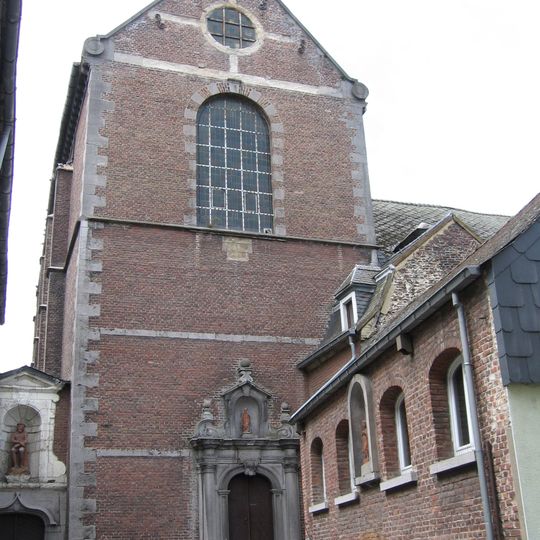
Saint-Ghislain Abbey, 7th-century Benedictine monastery in Saint-Ghislain, Belgium
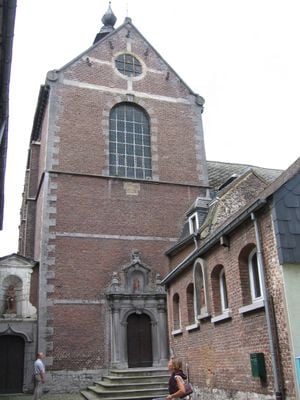
Saint-Ghislain Abbey is a former Benedictine monastery founded around 650 near the Haine in Hainaut. Its surviving abbey church, now the parish church, is a tall red-brick building with a steep gabled roof, lighter stone quoins and a stone band across the middle. High on the facade is a large round-arched window of small panes, with a small circular window above it; below the band, an entrance has a carved stone surround topped by a niche holding a figure. A lower brick wing with a tiled roof and smaller arched windows adjoins it on the right.
Saint Ghislain, a Frankish hermit, founded a monastery around 650 on land granted by King Dagobert I of Austrasia; the church was consecrated by Saint Aubert of Cambrai. Vikings sacked it in the late 9th century, and around 940 Gerard of Brogne introduced the Benedictine rule. On 2 June 965 Emperor Otto I confirmed a gift of 18 mansi at Villers-Saint-Ghislain. The French revolutionary authorities suppressed the abbey on 1 September 1796.
The monastery shaped local development through management of lands and promotion of crafts and learning. It served for centuries as a religious and economic center that influenced the surrounding community.
The archaeological site features explanatory panels describing the monastic layout and its role in community development. Wear sturdy footwear since the terrain is uneven with sections of exposed stonework.
The site witnessed a key political moment when Emperor Otto I confirmed a major land donation in 965. This imperial recognition underscores the monastery's importance in medieval European power structures.
The community of curious travelers
AroundUs brings together thousands of curated places, local tips, and hidden gems, enriched daily by 93,640 contributors worldwide.