Château de Boussu, Renaissance castle ruins in Boussu, Belgium
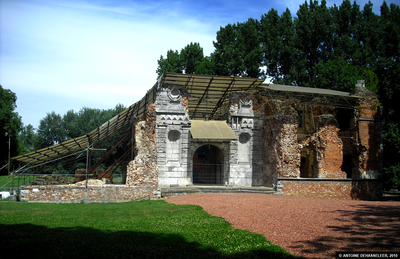
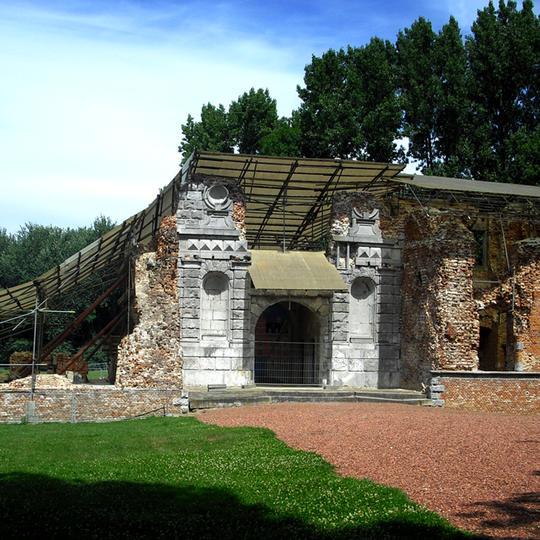
The Château de Boussu is an archaeological ruin in Hainaut; only its 16th-century gatehouse (châtelet) remains visible, now under a protective canopy. The facade centres on an arched entrance behind a metal gate, flanked by two light grey stone pillars with round blind niches, a triangular zigzag band and a rectangular upper recess. Exposed red brick and pale stone rubble walls stand on either side, and low brick walls run along the base.
A medieval fortress on the site was destroyed in 1478 during the war between France and Burgundy. From 1540 the Montois architect Jacques Du Broeucq rebuilt it for Jean de Hénin-Liétard, first count of Boussu and Grand Squire to Charles V, as a palace around a courtyard. Charles V stayed in 1545 and 1554, Philip II in 1549 and 1558, and Louis XIV celebrated his birthday there in 1655. Demolished in 1810, only the gatehouse survived.
The center showcases how the estate evolved over centuries under different families who shaped its landscape and buildings. Visitors can see how such properties functioned as seats of power and centers of local life.
The ruins are located at Rue du Moulin 43 in Boussu and are accessible for visitors to explore the remains at their own pace. The grounds are relatively open, allowing visitors to walk through gardens, see the ponds, and visit the center with its displays.
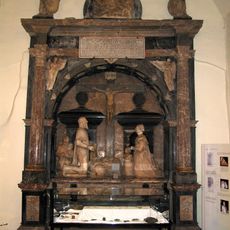
The lapidary museum is in the cellars of the gatehouse, not in the funerary chapel: it holds carved stones unearthed since 1991. The chapel of the Lords of Boussu stands 300 m away, beside the choir of Saint-Géry church, with a two-level vaulted crypt where the Hennin-Liétard and Caraman families rest.
The community of curious travelers
AroundUs brings together thousands of curated places, local tips, and hidden gems, enriched daily by 95,355 contributors worldwide.