Steen der Zeven Heerlijkheden, Historic boundary marker in Lommel, Belgium.
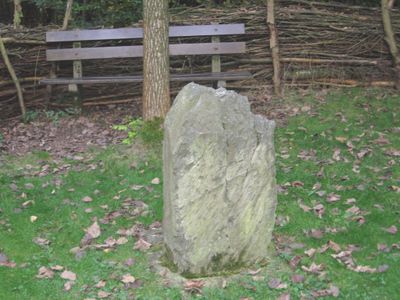
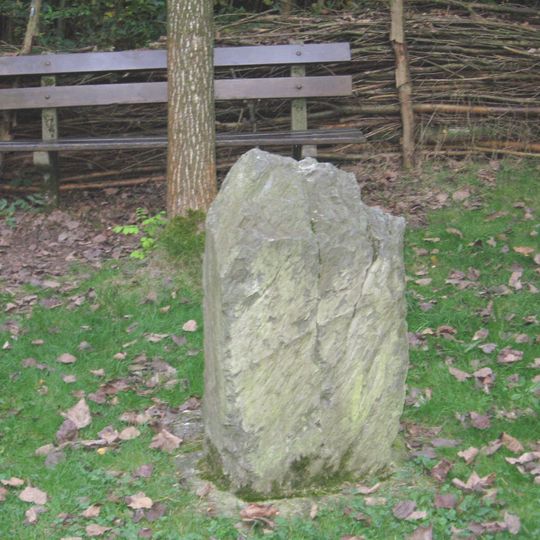
The Steen der Zeven Heerlijkheden is a single upright boundary stone of pale grey-green, roughly rectangular with a rounded, uneven top and slightly irregular sides tapering toward the top. Its coarse surface has a faint vertical crack down the front face and greenish discoloration near the base. It stands in grass scattered with fallen leaves, about 100 metres north of the hamlet Blauwe Kei, on the border of Lommel and Mol.
The stone was established in 1648 to mark boundaries between seven territories during a period of major territorial restructuring in the Low Countries. Following border adjustments in 1843, it came to rest entirely within Belgian territory.
The name Schoongars comes from "schoon gras", meaning fine grass or a fine meadow, and was written in many forms over the centuries. Since the Peace of Münster in 1648 the spot joined the Seven Lordships: Bergeijk and Lommel of the Dutch Republic, Balen, Dessel, Mol and Postel of the Spanish Netherlands, and Luyksgestel of the Prince-Bishopric of Liège. Folk tales held that blood came out of the stone if you pricked it with a needle or pin.
The stone stands in grass about 100 metres north of the Blauwe Kei hamlet, on the boundary between the provinces of Limburg and Antwerp. It is reached on foot; the ground around it is grass and can be uneven, so sturdy shoes help. Fallen leaves and a nearby bench and tree trunk mark the spot.
The stone was long confused with the nearby Blauwe Kei, a boundary marker between Mol and Postel, after a map by Philippe Vandermaelen mislabelled it; historians including Petrus Panken repeated the error. In 1981, after the stone was dug up and restored, residents of the Blauwe Kei hamlet stole it. Folk tales held that blood came out if you pricked the stone with a needle.
The community of curious travelers
AroundUs brings together thousands of curated places, local tips, and hidden gems, enriched daily by 94,427 contributors worldwide.