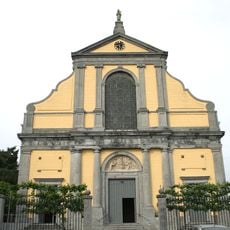
Église Saint-Géry, Medieval church in Belœil, Belgium.
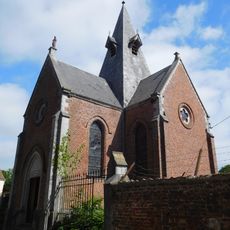
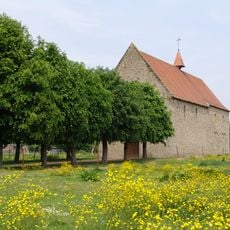
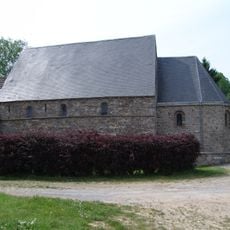
Église Saint-Géry is a neo-Romanesque church of rough grey-brown stone with a steep red corrugated roof. A square bell tower with a red pyramidal roof and metal cross stands at the crossing of the nave and a modest transept, pierced by round-arched openings. A single three-bay nave leads to a flat-chested sanctuary above a transverse crypt, and a grey stone wall with capped pillars runs in front.
Built around 1100 for a Benedictine priory founded in 1077, the church stayed unfinished after the priory was suppressed in 1119 and was attached to Saint-Ghislain Abbey. Judged ruinous in 1454, it was rebuilt on the original plans with a spire over the transept and an enlarged nave. Nearly demolished at the end of the 19th century, it was rebuilt from 1900 to 1904 under architect Sonneville, who replaced the wooden tower with the square bell tower.
The oak pulpit and confessionals date from around 1743 and are attributed to Ignace Fouquet of Tournai and Alexis Leblanc of Chièvres. A polychrome wooden Saint Géry from about 1739 is credited to the Tournai sculptor Cousin, and two adoring angels came from an old townhouse, probably 1757–1759.
The building is open to visitors during specific times and days, with regular Catholic services held here. It helps to check opening hours beforehand, especially if you want to visit during or outside of service times.
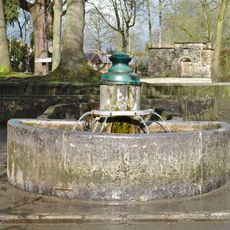
The crypt was rediscovered only in 1960, reached by a single seven-step stair descending from the sanctuary. Its hexagonal basin is a Roman relic, which led to the belief that the church stands on the site of a pre-Christian Roman temple, perhaps dedicated to a nymph.
The community of curious travelers
AroundUs brings together thousands of curated places, local tips, and hidden gems, enriched daily by 95,538 contributors worldwide.