Ledenika Cave, Show cave in Vratsa Municipality, Bulgaria
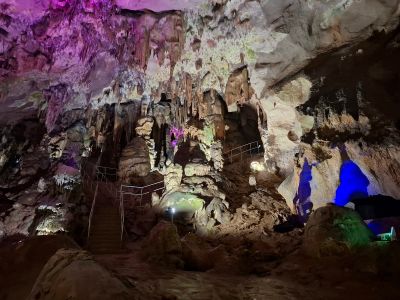
Ledenika is a show cave of about 320 m in length and 37 m of denivelation, with ten halls. Visitors pass from the Antechamber through the low passage called the Slide to the Small Hall, then to the Great (Concert) Hall, 60 m long, 45 m wide and up to 23 m high, known for calcite formations nicknamed the Crocodile, the Giant's Head and the Falcon.
Shepherds used the cave during Ottoman rule to store sheep's milk. Nenko Radev first surveyed and mapped it between 1922 and 1925. In 1927 Hristo Chomakov donated 100 decares of meadows and forest to the 'Veslets' tourist society in Vratsa. The cave was developed for tourism and opened in 1961, after being declared a natural monument by Council of Ministers Decree No. 2057 of 28 November 1960.
The cave's name comes from the ice that forms in the Antechamber and Small Hall from late November to May, when temperatures there drop below 0 °C; geomorphologist Vl. Popov studied these ice masses. Before tourism, shepherds stored sheep's milk inside. The Great Hall is also called the Concert Hall, and specialists describe the cave's acoustics as "divine".
Temperature varies significantly as you move deeper into the cave, starting very cold at the entrance and becoming warmer in inner sections. Bring appropriate clothing and watch your footing on the damp ground.
The insect Ledenikus, or Svetlomrazets, has been recorded only in this cave. Nenko Radev, who mapped Ledenika in the 1920s, noted that bats once filled every corner but retreated to the New Channel after mass visits began.
The community of curious travelers
AroundUs brings together thousands of curated places, local tips, and hidden gems, enriched daily by 93,573 contributors worldwide.