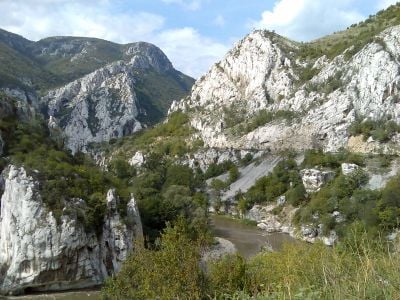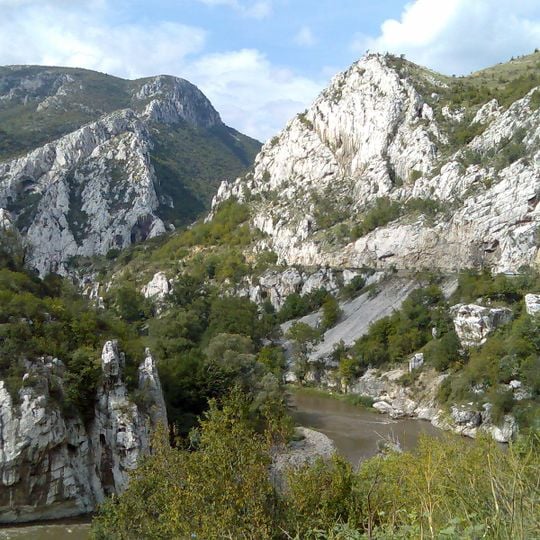
Iskar Gorge, River gorge in the Balkan Mountains, Bulgaria
Iskar Gorge is a natural canyon carved by the river through the Balkan Mountains, featuring tall limestone walls on either side of the water. The valley stretches across a long distance and includes settlements, farmland, and a railway line that winds through the rock formations.
The river carved its path through the mountains over millions of years, maintaining its course through major geological shifts. A railway was built through the valley in the late 1800s, connecting Sofia to northern Bulgaria and creating new settlements along the route.
The gorge takes its name from the Iskar, the only river that cuts straight through the Stara Planina chain. Over 50 settlements lie in the gorge and on its slopes, among them Lakathik, Lyutibrod and the town of Svoge, and several villa zones such as Romcha and Vlado Trichkov occupy its upper part. Near Lyutibrod the Cherepish Monastery stands on the right bank, and the rock walls called Ritlite rise on the left.
The 80.6 km section of the second-class road II-16 runs parallel to the railway from Reberkovo to Novi Iskar, switching between the right and left valley slopes at Cherepish Monastery, Svoge and Lukovo. The railway from Sofia to Mezdra passes through more than twenty tunnels and numerous bridges over the Iskar and its tributaries. The gorge is narrowest and most canyon-like north of Gara Bov, near Lakathnik, Cherepish Monastery and Lyutibrod.
The Cherepish Monastery, on the right bank southwest of Lyutibrod, keeps a silver-gilt reliquary and a gospel cover given by Tsar Ivan Shishman in the 14th century. Its church was rebuilt in 1612 and its frescoes were painted in 1843 by Zahari Zograf, who left his self-portrait among the figures.
The community of curious travelers
AroundUs brings together thousands of curated places, local tips, and hidden gems, enriched daily by 94,457 contributors worldwide.