Solnitsata, Archaeological site in Provadiya, Bulgaria
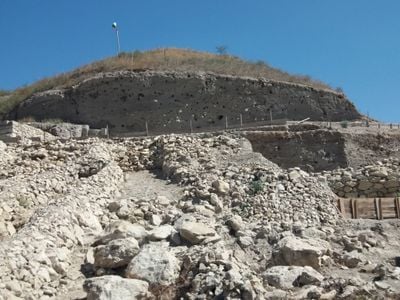
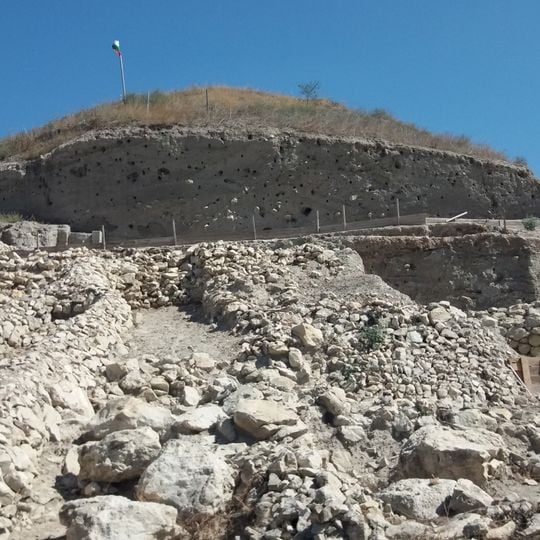
Solnitsata is an excavated tell near Provadia with two visible levels: low mounds and fragmentary wall lines of pale limestone rubble, and behind a row of thin posts a steep earthen bank pitted with small dark holes. Its stone defensive walls reached 4.3 m in thickness.
Solnitsata was discovered in the 1970s by Ara Margos, and excavations led by Vasil Nikolov began in 2005. The settlement existed from the mid-6th millennium BC, flourished between about 4700 and 4300 BC, and was destroyed by an earthquake. Its stone walls, up to 4.3 metres thick, are among Europe's earliest fortifications.
Salt was made by boiling mineral-rich spring water in ceramic vessels over hearths, then collecting the crystallised salt by hand. The pottery fragments left behind show how this process changed across the Karavovo IV–V, Gumelnitsa–Karavovo VI and Varna I–III cultures. Researchers link the surplus salt to the rich graves of the Varna Necropolis (c. 4500–4300 BC).
The excavated area shows low limestone rubble, fragmentary wall lines and a terrace edge marked by thin posts below a steep, hole-pitted earthen bank. Ground is uneven and bare; wear sturdy shoes. The site lies near Provadia, and the setting is open, so plan for sun and wind exposure.
Solnitsata's defensive walls reached 4.3 metres in thickness, among the earliest known fortifications in Europe. Archaeologists link the settlement's end to a strong earthquake, probably the same one that destroyed horizon VII at the Durankulak settlement mound. Excavations led by Vasil Nikolov began in 2005; the site had been found in the 1970s by Ara Margos.
The community of curious travelers
AroundUs brings together thousands of curated places, local tips, and hidden gems, enriched daily by 93,603 contributors worldwide.