Marcianopolis, Roman archaeological site in Devnya, Bulgaria
Marcianopolis lies at the site of modern Devnya, Bulgaria, and has been only partially excavated. Visible remains include an amphitheatre, stretches of ancient streets, and the House of Antiope, a late 3rd- or early 4th-century Roman villa whose mosaic floors are displayed in the Museum of Mosaics, some still in situ. The surrounding ground is paved with large, irregular pale grey and off-white stone slabs laid in a rough grid, with wide soil-filled gaps and a raised rectangular slab over a dark channel.
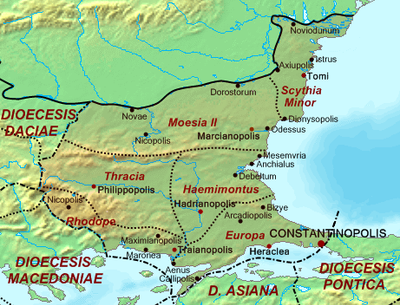
Trajan renamed the Greek city of Parthenopolis after his sister Ulpia Marciana following the Second Dacian War, which ended in 106. Under the Severans it prospered until a Gothic raid in 248–249; Diocletian made it the centre of Moesia Secunda and rebuilt it in the late 3rd and early 4th century. Attila's Huns destroyed it in 447, Justinian I restored and fortified it, and an Avar raid finished it off in 614–615.
The Museum of Mosaics in Devnya keeps the floors of the House of Antiope, a Roman villa of the late 3rd or early 4th century AD, some still in situ. The city's name comes from Ulpia Marciana, sister of Trajan; the 6th-century historian Jordanes tells that a golden vessel slipped from a girl of her retinue into a river, and Trajan founded the city there.
The site can be visited year-round, and the museum displays Roman and Byzantine artifacts to help understand the remains. Wear comfortable shoes and allow time to explore the scattered ruins across the area.
A hidden hoard of roughly 100,000 silver coins was unearthed in 1929, buried during a raid in the 3rd century. This discovery reveals how residents hid their valuables when danger approached.
The community of curious travelers
AroundUs brings together thousands of curated places, local tips, and hidden gems, enriched daily by 93,500 contributors worldwide.