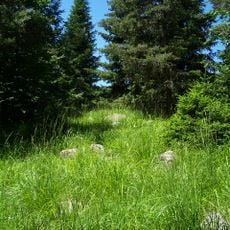
Тъмната гора, Protected forest reserve in Western Rhodopes, Bulgaria
Tamna Gora is a maintained forest reserve on gneiss bedrock in the Western Rhodopes, in the Kovachevitsa area along the upper Kanina River, between 1400 and 1600 m elevation. Beech and fir grow in the lower parts, while old spruce stands dominate higher up; the forests average over 150 years, and some spruces exceed 50 m in height.
The reserve was established by Decree No. 1153 of the Council of Ministers on 10 October 1948, initially covering about 32.58 hectares. It was created to protect centuries-old fir, beech and spruce forests. On 25 July 1989 the reserve, until then called Karaorman, was renamed Tamna Gora.
The reserve's name changed from Karaorman to Tamna Gora on 25 July 1989. Its old-growth forests, with trees over 150 years old, include spruces taller than 50 metres. The area is also known for the Rhodope snowbell (Soldanella rhodopaea) and the Rhodope toothwort (Lathraea rhodopea), two plants that receive special protection measures.
The reserve lies in the upper basin of the Kanina River, in the land of Kovachevitsa, between 1400 and 1600 m. Snow cover lasts from early December to late March, and layers over 15 cm persist into late spring. January temperatures average 0–2 °C, July 14–18 °C, with winter temperature inversions.
The reserve shelters four Balkan endemic plant species and one Bulgarian endemic, among them the Rhodope snowbell (Soldanella rhodopaea) and the Rhodope toothwort (Lathraea rhodopea), both subject to special protection measures. Over 50 medicinal plants also grow here.
The community of curious travelers
AroundUs brings together thousands of curated places, local tips, and hidden gems, enriched daily by 93,992 contributors worldwide.