Thracian Tomb and Sanctuary, Ancient tomb and sanctuary in Pomorie, Bulgaria.
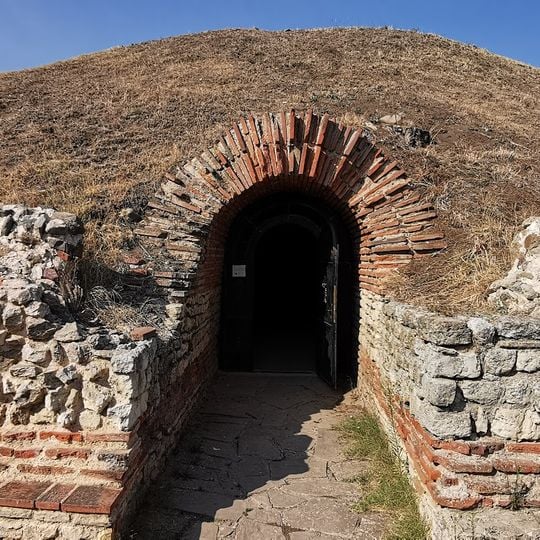
The Thracian Tomb is an underground burial chamber reached by a 22-meter corridor that opens into a circular room nearly 12 meters across. A hollow column stands at the center of this chamber.
Dated to the 2nd–3rd century AD, the tomb stands in the necropolis of ancient Anchialos, today's Pomorie. It combines a Thracian domed tomb with a Roman mausoleum beneath an 8 m mound. The hollow central column and the lighting through its opening point to solar rites; Prof. Alexander Fol linked them to the cult of Sabazios, called Apollo by day and Dionysus at night. Restored in 1958–1959, it was listed as an architectural monument in 1965.
Local people call it the Hollow Mound. According to Prof. Alexander Fol, priests read the will of the god Sabazius, called Apollo by day, from sunlight passing through the hollow column at noon; at night they read flames from the altar hearth. The five niches probably held the urns of the dead.
The tomb lies about 1 km from Pomorie and 300 m from the Pomorie–Burgas road, in the area of the fruit-growing station. From 1 June to 15 September it is open daily 10:00–18:00, with a lunch break from 12:00 to 13:00. From 16 September to 31 May, access is arranged by booking through the Pomorie Historical Museum.
No bones, urns or sarcophagi were ever found inside, so the tomb's use as a mausoleum remains unproven. The hollow central column, a possible altar-fireplace and the light entering through its opening suggest instead that priests read the will of Sabazios, called Apollo by day and Dionysus by night, from the sun's rays at zenith and from flames reflected on the night sky.
The community of curious travelers
AroundUs brings together thousands of curated places, local tips, and hidden gems, enriched daily by 94,599 contributors worldwide.