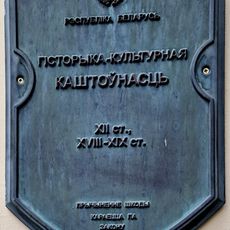
Old Grodno Castle, Medieval castle in Hrodna, Belarus
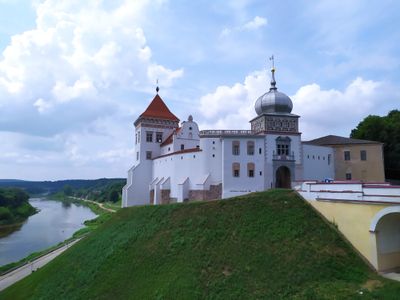
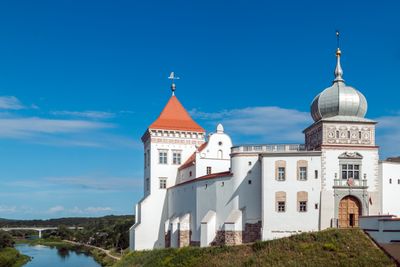
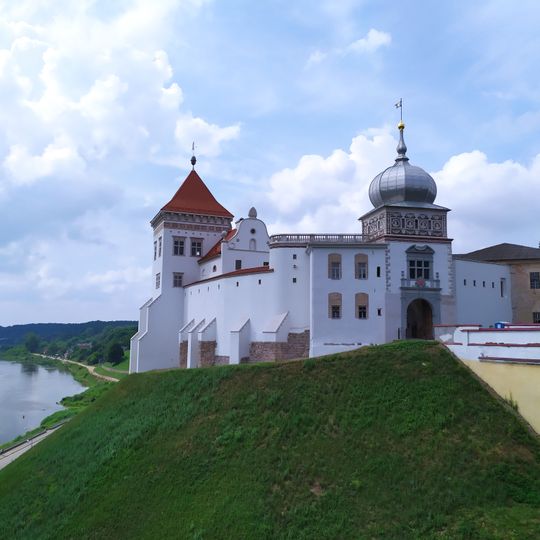
Old Grodno Castle stands on a steep grassy hill above the Neman River, its white walls punctuated by a square tower with a red pyramidal roof and spire, stepped buttresses, and a gate tower crowned by a silver onion dome. The complex includes a palace, fragments of defensive walls, and the ruins of the Lower and Upper churches.
A wooden-and-earth stronghold was first mentioned in 1128, with a brick church inside the ramparts dated to the second half of the 12th century. Around 1419 Grand Duke Vytautas replaced it with a brick castle of five towers and walls about 3 m thick, of which only fragments remain. Stefan Batory made it his main residence during the 1577–1582 Livonian war and had it rebuilt in Mannerist style in 1583–1586; he died there on 12 December 1586.
From 1673, on the initiative of Lithuanian deputies, every third ordinary Sejm of the Polish-Lithuanian Commonwealth was held here. Chancellor Krzysztof Zygmunt Pac supervised the rebuilding of 1673-1678, which added a two-storey building by the Neman wall for the Chamber of Deputies and the Senate Chamber; a tablet above the castle gate commemorated the work. Kings Kazimierz Jagiellończyk and Stefan Batory died at the castle.
The castle is visible and accessible from the surrounding area, with exhibitions inside displaying medieval artifacts and objects discovered during excavations. Check ahead to learn which rooms are open, since not all sections may be available for visitors at all times.
The castle's name covers the whole complex on Castle Hill, including the ruins of the Lower and Upper churches and the princely chambers. In 1578 an inventory recorded four brick towers, and a 1567–1568 engraving labels the building Arx Latericia, meaning a brick structure.
The community of curious travelers
AroundUs brings together thousands of curated places, local tips, and hidden gems, enriched daily by 93,849 contributors worldwide.