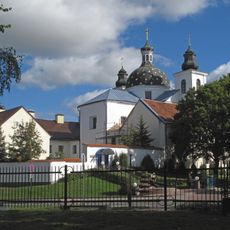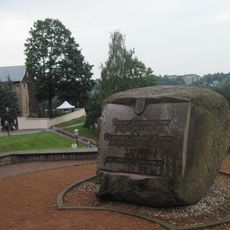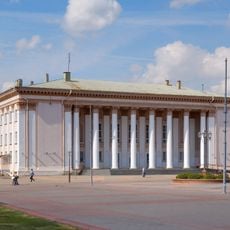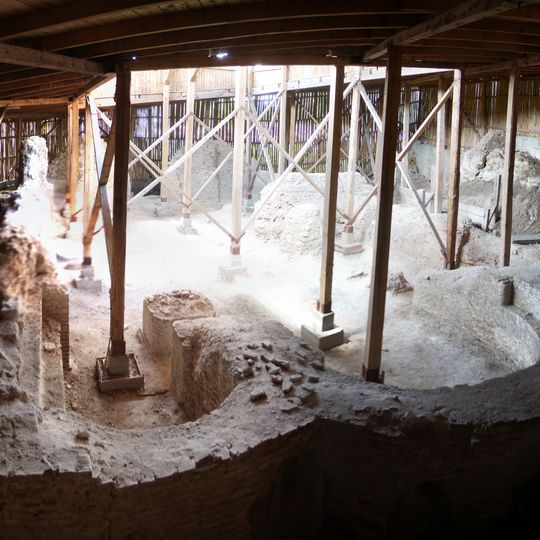
Lower church in Hrodna, Eastern Orthodox church building in Hrodna, Belarus.
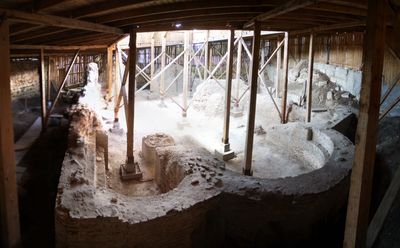
The Lower Church is the excavated ruin of a 12th-century Orthodox church on the Hrodna detinets, north of the palace. Its walls stand 2–3.5 m high; the building was six-pillared, three-naved and three-apsed, measuring 18.4 by 11.7 m, with cut corners and a lead-covered roof. Polished boulders of different colours were set into the walls, and the upper parts carried majolica tiles.
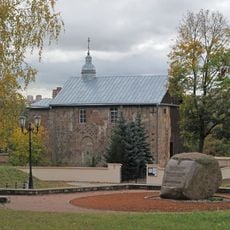
Built in the 12th century beside a princely palace, the church was destroyed by fire in 1183, as the Ipatiev Chronicle records lightning and thunder striking Hrodna's stone churches. Its buried walls later supported the Upper Church, a small Gothic chapel from Vytautas's reign. Archaeologists J. Jodkowski and Z. Durczewski uncovered the ruins in 1932–1939.
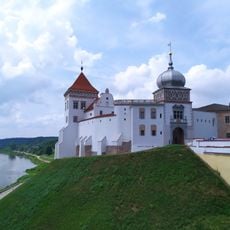
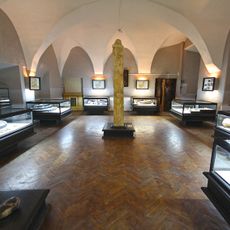
The name "Lower" comes from its position beneath the later Upper Church, which was built over its buried walls. After the 1183 fire the ruins held an elite necropolis; one burial contained a massive man wearing a gold ring, now displayed in the Old Castle. The site is shown to visitors as part of the Hrodna State Historical and Archaeological Museum.
The church no longer stands as a place of worship: its walls survive to a height of 2–3.5 m and are covered by a pavilion on the Hrodna castle hill, north of the palace. The remains are shown as part of the Hrodna State Historical and Archaeological Museum, so access follows the museum's opening arrangements. Look for the polished boulders set into the lower walls and the majolica tiles in the upper zone.
The church walls stand only 2–3.5 m high, and among the polished boulders set into them are grey-pink, black-green and red-violet stones. A glazed majolica square of brown and green tiles survives on one window pier. A 27 kg fragment of a bell found in the excavations bore part of an inscription ending in "…рабу…".
The community of curious travelers
AroundUs brings together thousands of curated places, local tips, and hidden gems, enriched daily by 95,316 contributors worldwide.