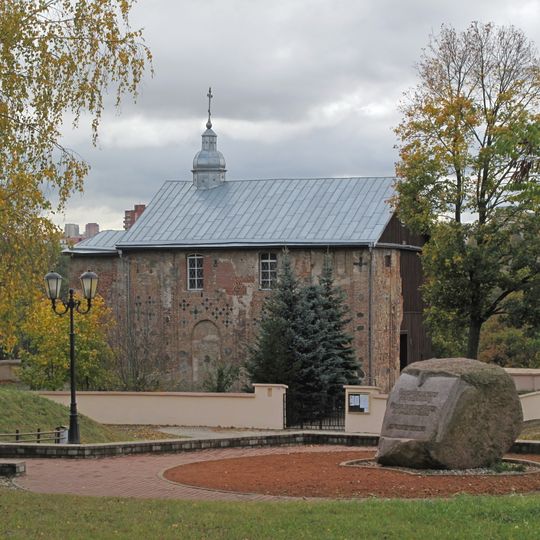
Kaloža Church, Orthodox church in Hrodna, Belarus
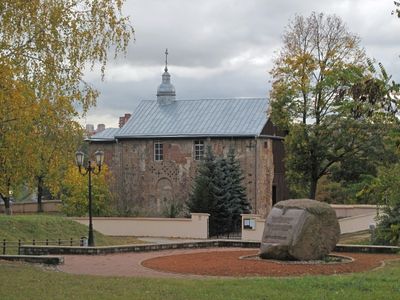
Kaloža Church stands on the high bank of the Neman River in Hrodna. Its rough, dark stone walls, patched with lighter stones, are pierced by small arched windows with white frames, and a steep grey metal roof carries a small octagonal drum, a dark cupola and a thin cross. A low pale-pink wall with a grey metal gate and a large grey boulder stands before it.
The church was built in the 1180s, probably during the reign of the Hrodna princes Boris and Gleb Vsevolodovich, and was consecrated to their patron saints. A first written mention dates from 1138. After the fire of 1184 destroyed the cathedral of ancient Gorodena, it became the main city temple. In 1853 a landslide of the Neman bank brought down the south wall and apse; restoration followed in 1896–1906, and the last cycle ran in 2017–2019.
The ceramic vessels embedded in the walls and vaults create a special acoustic quality that amplifies the sound of male choir singing during Sunday services. This building technique comes from the Hrodna architectural school tradition and produces a resonance that visitors can still experience today during religious ceremonies.
The church stands on the high bank of the Neman at the mouth of the Haradnichanka, below Castle Hill. The slope is unstable: landslides in 1853 brought down the south wall and apse, and the wooden replacements from the 1896–1906 restoration still close that side. Approach from the riverbank path and watch for uneven ground near the boulder in front of the low pink wall.
The ceramic vessels embedded in the walls and vaults were a technical innovation to reduce weight and improve acoustics. This method is found in only a few medieval churches in the region and makes the building a rare example of this construction technique.
The community of curious travelers
AroundUs brings together thousands of curated places, local tips, and hidden gems, enriched daily by 93,849 contributors worldwide.