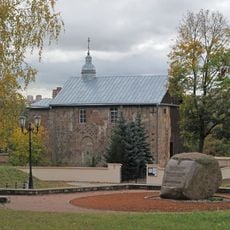
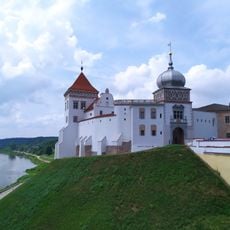
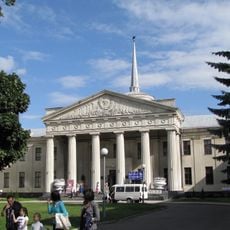
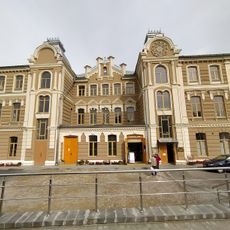
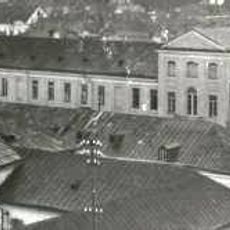
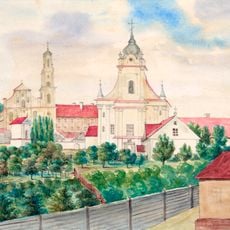
Church of Our Lady of the Angels and former Franciscan monastery in Hrodna, Baroque Catholic church and Franciscan monastery in Hrodna, Belarus.
The Church of Our Lady of the Angels is a brick structure built in the Baroque style with decorated exterior details and richly appointed interior spaces featuring religious motifs. The attached former monastery extends behind the main church building, forming a connected complex.
Founded in 1635 by Upita starosta Eustachy Kurcz and Zuzanna Tyszkiewicz, the monastery was first built of wood with 24 cells. A brick church replaced it from the 1670s; the facade was finished in 1700 and the church consecrated on 22 October 1744 by Bishop Józef Dominik Puzyna. After the 1863 uprising it served as a Russian prison for Polish priests until 1919.
The monastery became the seat of the Grodno custody of the Franciscan province of Lithuania after that province was created in 1686, with several nearby monasteries such as Drohiczyn and Świsłocz under it. The church was consecrated on 22 October 1744 by Józef Dominik Puzyna, bishop of Livonia, and a parish was established that May. The main relic is a 17th-century icon of Our Lady of the Angels.
The complex stands on the left bank of the Neman, on the former Market of the Zaniemien district, beside the old river crossing that linked routes from the Crown to Lithuania. The church and monastery enclose an irregular four-sided courtyard; the main entrance once led through the north gable of the western wing. The bell tower, built in 1749–1750, held three bells and a clock.
The organ, funded by Konstancja Łazowa in 1750 for 3,000 złoty plus 150 tymf coins for transport, is the oldest surviving in Belarus; its late-Baroque case and some pipes remain, built by organmaster Mateusz Krajewski, and it is the only organ certainly made by Prussian masters.
The community of curious travelers
AroundUs brings together thousands of curated places, local tips, and hidden gems, enriched daily by 94,453 contributors worldwide.