New Grodno Castle, Royal palace in Hrodna, Belarus
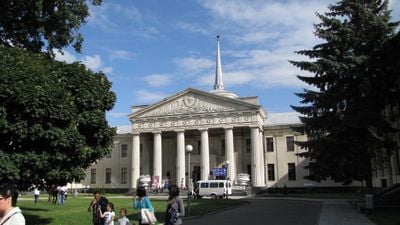
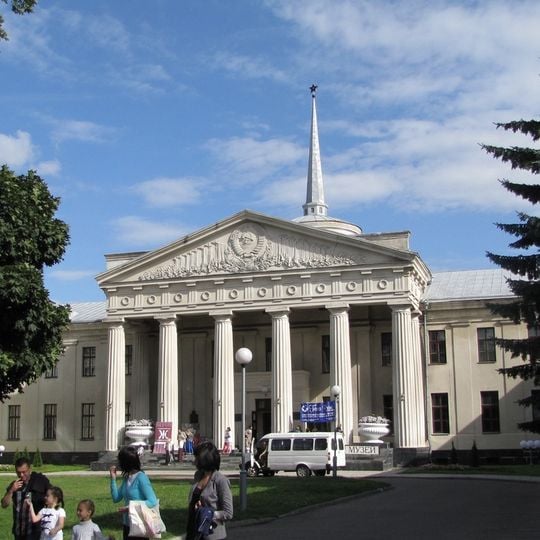
New Grodno Castle is a horseshoe-plan palace built in 1737–1742 for Augustus III, with a main block whose central projection carries a triangular pediment carved with relief figures and a medallion, and a tall slender spire rising behind it. Symmetrical wings with rows of rectangular windows extend to either side behind a low wall and gates; a grey sign with black lettering reads "МУЗЕЙ". The main corps was rebuilt after 1952 in socialist-realist style, while the side wings partly keep their baroque appearance.
Built from 1737 to 1742 for Augustus III on the site of the medieval Lower Castle of Vytautas, the palace was designed by Carl Friedrich Pöppelmann, with Johann Friedrich Knöbel, Joachim Daniel von Jauch and later Giuseppe de Sacco working on it. A fire in the late 1740s led to rebuilding and to Knöbel's Baroque chapel of 1750–1752. Four general sejms met here, in 1744, 1752, 1784 and 1793; the last signed the Second Partition treaty with Russia on 22 July 1793, and Stanisław August Poniatowski signed his abdication here in 1795.
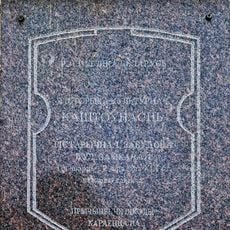
Since 1993 the palace has housed the Grodno State Historical and Archaeological Museum. Its displays cover the 2018 find of 12th-century plinth-brick ruins on the castle grounds and the April 2026 discovery of a 12th-century church in the courtyard. A plaque placed in 1994 marks the 200th anniversary of the Kościuszko Insurrection.
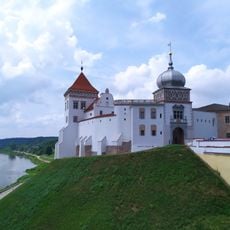
The museum entrance is on the right side of the facade, marked by a grey sign reading "МУЗЕЙ"; a canopy over the doorway carries a blue sign with "55" and "100". The palace stands opposite the Old Castle, and the two are linked by an arch bridge over the Neman. The building now houses the Grodno State Museum of History and Archaeology, opened here in 1993.
The 1793 Grodno Sejm, held here under pressure from Russian envoy Jacob Sievers, ratified the Second Partition treaty with Russia on 22 July 1793. Among the senators present was Michał Kleofas Ogiński, later famous as a composer. The hall's layout is known from Wilhelm Schlemüller's 1752 diary: benches in a semicircle, a throne under a red silk canopy, and coats of arms of the Commonwealth's voivodeships above the windows.
The community of curious travelers
AroundUs brings together thousands of curated places, local tips, and hidden gems, enriched daily by 93,850 contributors worldwide.