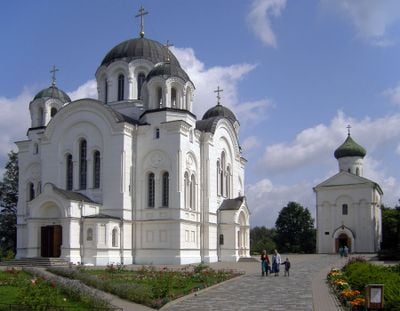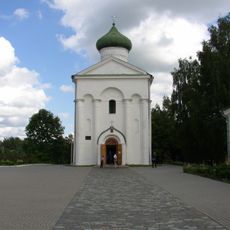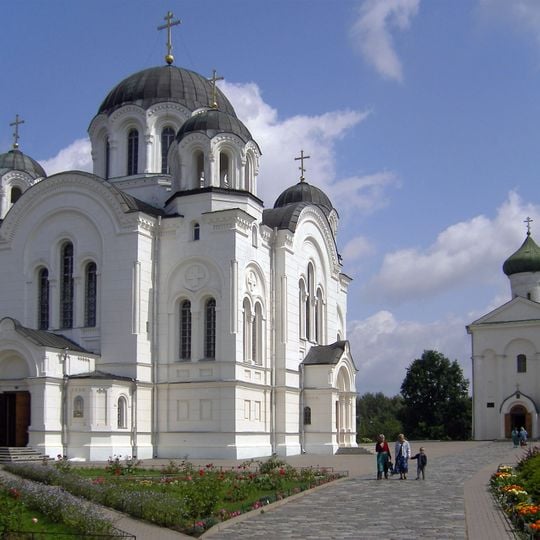
Convent of Saint Euphrosyne in Polack, Orthodox monastery in Polotsk, Belarus.
The Convent of Saint Euphrosyne in Polotsk is a stauropegic women's monastery of the Belarusian Orthodox Church. Its oldest building is the Transfiguration Church, a six-pillared, three-nave cross-domed structure of plinthite masonry built by the architect Ioann in 1152–1161. The complex also includes the Holy Cross Cathedral, a five-domed church in the Neo-Byzantine style designed by V. F. Korshikov and built in 1897, the 1847 refectory Church of Saint Euphrosyne, and a 16th-century gate-bell tower.
Founded in 1125 by Princess Euphrosyne of Polotsk, who settled by the Transfiguration Church in Selce with her sister Evdokia and cousin Evpraxia. In 1161 the stone Transfiguration Cathedral was built by the architect Ioann, and Euphrosyne donated a gilded altar cross made by jeweler Lazar Bogsha. The cross was taken from Polotsk in the 13th century and returned by Ivan the Terrible in 1563. In 1580 the monastery passed to the Jesuits, returned to Orthodoxy in 1654, and was again Jesuit until 1820. It was restored in 1840, and the cross was returned in 1841. Closed in 1921, the cross disappeared in 1941.
The convent is stauropegic, directly under the Belarusian Orthodox Church's head rather than a local bishop. Its name comes from the Saviour (Spas) and Saint Euphrosyne, who took the veil here; her sister Evdokiya and cousin Evpraksiya followed. The 12th-century frescoes in the Transfiguration Cathedral were uncovered in 1929 by a team including Igor Grabar and Grigory Chirikov.
The monastery is best visited during daytime when the religious sites are fully accessible and visitors can view the relics. The grounds are walkable and allow time to observe the different churches and buildings at a leisurely pace.
The Transfiguration Cathedral's hidden-row brickwork sets each brick course back only 1–2 cm from the facade, giving the walls a fine decorative texture. Above the octagonal section of the western pillars, square slabs of dense dark bog oak were built into the masonry as a transition to the arches.
The community of curious travelers
AroundUs brings together thousands of curated places, local tips, and hidden gems, enriched daily by 94,370 contributors worldwide.