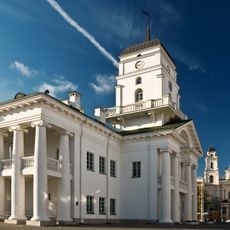
Manor of Pšazdziecki family in Minsk, Classical mansion in Minsk, Belarus.
The Manor of Pšazdziecki family at Freedom Square 15 is a two-storey rectangular mansion under a hipped roof, its central risalit flanked by flat pilaster strips and crowned by a triangular pediment with a semicircular window in the tympanum. A band of dentils runs beneath the pediment cornice, and a balcony with an openwork metal railing on wooden consoles sits above the entrance on the first floor. The courtyard facade is plain, with rectangular windows lacking surrounds.
The estate is first documented in 1775 as the stone house of the Pšazdziecki counts, owners of Zaslaŭje. In 1799 Michał Pšazdziecki sold it for 40,000 Polish zlotys to Andrei Stankievič, and from 1826 it belonged to Juryj Kabylinski, secretary of the Minsk nobility assembly. In 1872 the Minsk men's spiritual school moved in, and after the 1881 fire the buildings were restored.
The estate's name comes from the Pšazdziecki counts, owners of Zaslaŭje, who sold it in 1799 to the pharmacist Andrei Stankievič. From 1826 it belonged to Jury Kabylinski, secretary of the Minsk nobility assembly, who kept the city's first private kunstkamera there: coins, minerals, antiquities, old books and manuscripts, among them a Statute of the Grand Duchy of Lithuania and a map of Christopher Columbus. After his death the exhibits went to the Vilnius Museum of Antiquities.
The building at Freedom Square 15 houses Mikhail Savitsky Art Gallery, opened on 8 May 2012 after restoration; its nine halls display about forty works from the National Art Museum, the Museum of Minsk History and the artist's family. The gallery also reconstructs Savitsky's studio and the interior of his academic painting, graphic and sculpture workshops founded on his initiative in 1981. The former northern wing no longer exists, so look for the main house and the surviving southern wing at Square 15 and 13.
During the building's reconstruction, late-18th-century wall paintings were uncovered on the second floor. The 1851 inventory also listed 14 Dutch stoves faced with glazed tiles and 6 with white tiles; all were destroyed after the war.
The community of curious travelers
AroundUs brings together thousands of curated places, local tips, and hidden gems, enriched daily by 93,802 contributors worldwide.