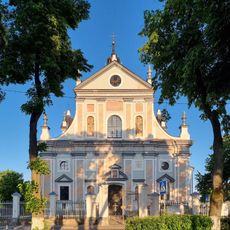
Church of Saint Euphemia in Niasviž, Catholic church building in Belarus
The Church of Saint Euphemia in Niasviž is a Baroque stone building with sturdy walls and small windows situated on an elevated area of the town. Its simple exterior contrasts with an interior featuring marble altars, paintings, and religious sculptures crafted with intricate artistic details.
The church and Benedictine monastery were built together between 1590 and 1596, founded by Mikalaj Kryštof Radzivił the Orphan and his brother Cardinal Jurij Radzivił; it was the first female Catholic monastery in the region. The first service was held on 12 June 1597. After the 1863 uprising the church was closed, reworked inside by 1864 and handed to the Orthodox Church in 1866, while the monastery was closed in 1876 and turned into barracks. It functioned again in 1920–1945, and since 1994 it has housed a pedagogical college.
The church takes its name from Saint Euphemia, which matched the name of the founder's wife, Elżbieta Euphemia Wiśniowiecka. The first service was held on 12 June 1597. Since 1994 the former monastery has housed a pedagogical college, continuing the teaching institute founded in 1984.
The complex stands at 8 Chkalova Street, by the south-eastern bastion of the former fortress town, so two lines of fortifications ran along its boundaries. The main entrance is the 18th-century gate tower, set asymmetrically in the north wing on the axis of the inner courtyard. The building now houses a pedagogical college, so the church interior is not open as a place of worship.
The monastery's gate tower, added in the 18th century, is the main entrance on the courtyard's central axis. Its three tiers step inward, each with pilasters at the corners, and it is topped by a shaped cupola with a spire. The doors are fitted with artistic ironwork.
The community of curious travelers
AroundUs brings together thousands of curated places, local tips, and hidden gems, enriched daily by 94,458 contributors worldwide.