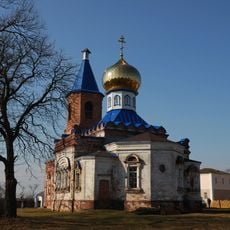
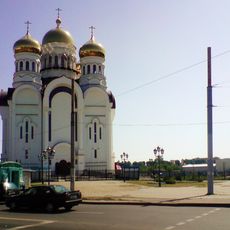
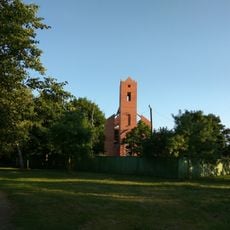
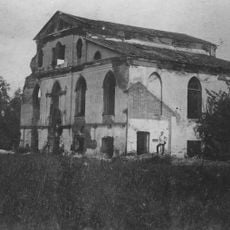
Church of the Holy Trinity in Bychaŭ, Eastern Orthodox wooden church in Bychaŭ, Belarus.
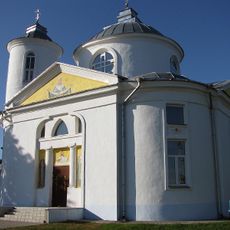
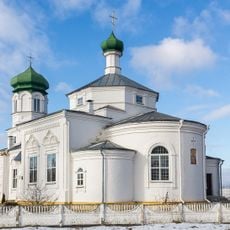
The Church of the Holy Trinity in Bychaŭ is a wooden cross-domed church built in 1890–1899 on a plastered brick foundation. A two-tier octagonal bell tower with rectangular upper and semicircular lower openings rises above the rectangular narthex and vestibule. An eight-sided light drum, 8 m in diameter and 12.5 m high, carries a faceted cupola with a small onion dome. Three entrances have wide stone porches on two wooden columns each.
The wooden church was built between 1890 and 1899, though some sources place its construction in the mid-19th century. From 1953 to 2008 (or 2010, depending on the source), it housed the wonder-working Barkalabava Icon of the Mother of God, painted in 1659 and restored in 1979. The icon was returned to the restored Barkalabava Monastery, and a copy remains in Bychaŭ. The church was consecrated by a bishop on 29 December 1967; the original consecration date is unknown.
This church remains an active gathering place where residents come for services and religious celebrations that follow Orthodox traditions. The interior and its use reflect how faith has been woven into the daily life of the community.
The site is open to visitors who approach it with respect for its role as an active place of worship. Keep in mind that you are entering a functioning religious space, so modest dress and quiet behavior are appropriate.
The church kept the wonder-working Barkalabava Icon of the Mother of God, painted in 1659, from 1953 until 2008 (some sources say 2010), when it returned to the restored Barkalabava monastery; a copy remains here. The interior has a three-tiered iconostasis, and the eight-sided light drum over the crossing measures 8 m across and 12.5 m high.
The community of curious travelers
AroundUs brings together thousands of curated places, local tips, and hidden gems, enriched daily by 94,349 contributors worldwide.