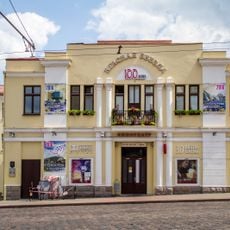
Tyzienhaŭz Palace in Hrodna, Baroque palace in Hrodna, Belarus
Tyzienhaŭz Palace was a one-storey brick residence with a P-shaped plan, high hipped roof and oval belvedere topped by a dome and a sculpture of Ceres above the main entrance. Its green walls, white stucco details and red tiles framed a trapezoidal cour d'honneur off Hrodna's market square. The main façade, extended by a wing with a riding hall, measured over 140 metres.
Built in the 1760s–1780s as the administrative centre of the royal estates in Gorodnica, the palace was supervised by Antoni Tyzenhauz but owned by King Stanisław August Poniatowski. After Tyzenhauz's fall, Prince Stanisław Poniatowski extended it. From 1795–1796 it housed Prince Nikolai Repnin, and later served as the residence of governors, including Mikhail Kutuzov, until it burned in 1915.
The palace hosted a ball described by traveller William Cox, who noted Polish and English folk dances and an elegant supper. In the 1770s performances with Anna Davia likely took place here, and the site later became the residence of Russian governors, including Mikhail Kutuzov and Pyotr Stolypin.
The main palace burned down in 1915, so there is no building to tour; look instead for the surviving parts of the ensemble in Hrodna's Haradnica district, including the palace theatre, now a puppet theatre, and the Czartoryski palace. The former guest house, known as the vice-administrator's house, and the Curved Official building, now a music school, also stand. The botanical garden founded by Jean-Emmanuel Gilibert lies northeast of the former palace.
The palace burned down in 1915 during the First World War, so no fourth floor or apartments exist today. Of the whole complex, only the palace theatre, now used by a puppet theatre, and the Czetwertyński palace survive, along with the guest house and the Curved Officina.
The community of curious travelers
AroundUs brings together thousands of curated places, local tips, and hidden gems, enriched daily by 94,362 contributors worldwide.