Statue of Notre-Dame-du-Saguenay, Religious statue on Cap Trinité, Rivière-Éternité, Canada
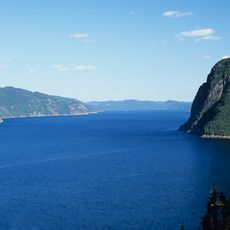
The statue of Notre-Dame-du-Saguenay stands on Cap Trinité at the mouth of Baie Trinité near Rivière-Éternité. Sculpted by Louis Jobin in 1881 from white pine and covered with thin lead sheets, it is 7.5 metres tall and weighs over 3 tonnes. The Virgin has joined hands and wears a white tunic with a gold-edged mantle.
Louis Jobin carved the statue in 1881 from white pine covered with thin lead sheets. It was commissioned after travelling salesman Charles-Napoléon Robitaille fell through winter ice near Lac Saint-Jean and prayed to the Virgin; he was found stranded on the ice farther on. The 3-tonne figure was shipped by steamer, then hauled up Cap Trinité in fourteen pieces over eight days.
The statue was carved in honour of the Virgin Mary after travelling salesman Charles-Napoléon Robitaille fell through the ice on a winter journey toward Lac Saint-Jean and prayed to be saved. It stands on Cap Trinité at the mouth of Baie Trinité, near Rivière-Éternité. In 2008 the Royal Canadian Mint issued a 25-cent coin bearing its image.
The statue stands on Cap Trinité, a steep cliff wall at the mouth of Baie Trinité near Rivière-Éternité; the cliff face makes landing a boat impossible, so the site is seen from the water or from viewpoints across the Saguenay. In 1881 the pieces were hauled up in stages of about 50 feet over eight days. Look for the wooden base built to hold the monument.
The statue was shipped from Quebec City aboard the Union steamer, but Cap Trinité's steep wall prevented docking, so it was left at L'Anse-Saint-Jean. Two men in a rowboat then towed it about nine miles through the water before it was hauled up in 1881.
The community of curious travelers
AroundUs brings together thousands of curated places, local tips, and hidden gems, enriched daily by 92,613 contributors worldwide.