Earnscliffe, Gothic Revival manor in Ottawa, Canada
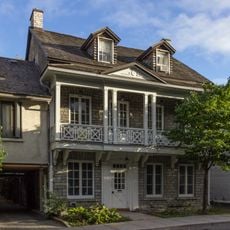
Earnscliffe is a Gothic Revival manor of light grey stone, built on a cliff above the Ottawa River. Its main facade has two projecting gabled wings, a dark slate roof with green copper trim, four tall stone chimneys, tall white-framed windows and a broad white-railed balcony across the second storey. Lower side wings extend left and right.
Thomas McKay's company built the manor for his son-in-law John McKinnon from 1855 to 1857. After McKinnon died in 1866 it passed to Thomas Keefer, then in 1868 to railway developer Thomas Reynolds, who gave it the name Earnscliffe. Reynolds's son sold it in 1883 to Sir John A. Macdonald, who added to the structure in 1888 and died in his room here in 1891 after a stroke.
The name Earnscliffe is an archaic term for "eagle's cliff", said to have been suggested by Sir John A. Macdonald, who proposed the Old English word earn for eagle. A plaque and tree on the grounds commemorate the CANLOAN program and its participants. Since 1930 the house has been the residence of the British high commissioner to Canada.
The property at 140 Sussex Drive is normally closed to visitors, with public access limited to special events like Doors Open Ottawa. You can still enjoy views of the exterior from the street and explore the surrounding area at any time.
The name was debated at the house: Reynolds called it Eaglescliffe, and Sir John A. Macdonald proposed the Old English word earn for eagle, which was accepted. A plaque and tree on the grounds commemorate the CANLOAN program and its participants.
The community of curious travelers
AroundUs brings together thousands of curated places, local tips, and hidden gems, enriched daily by 92,724 contributors worldwide.