Hogg's Hollow Bridge, Highway bridge in North York, Ontario, Canada
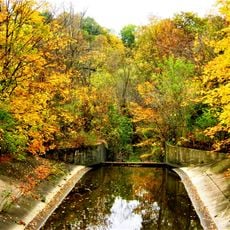
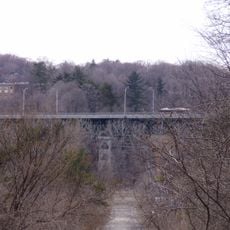
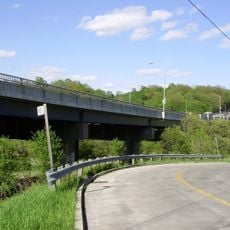
Hogg's Hollow Bridge comprises four separate structures that span the West Branch of the Don River Valley while supporting 14 lanes of Highway 401 traffic. The structures connect Wilson Avenue with York Mills Road across a deep ravine.
The inner under-deck truss bridge was built from early 1928 and opened on January 5, 1929, carrying traffic over the deep ravine between Wilson Avenue and York Mills Road. In December 1952 the Toronto Bypass, today's Highway 401, was routed across it with an added south truss bridge. The outer steel girder collector spans opened in December 1965 when the highway was widened to a collector-express system.
The name Hogg's Hollow comes from James Hogg, a Scottish settler who ran a whisky distillery and grist mill here from 1824. The mill and distillery drew traffic to the ravine, and the community that grew around them kept his name. The bridge name preserves this early settlement.
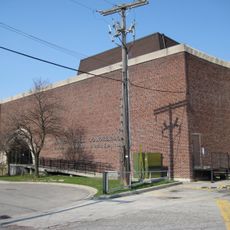
The bridges are best seen from Yonge Street looking northwest, north of York Mills Road and Wilson Avenue. An access road off the westbound on-ramp descends to the valley floor but is closed to regular vehicles, reserved for Ministry of Transportation crews and the TTC's Macdonald-Cartier emergency building.
The four decks carry about 400,000 vehicles on an average weekday, making this the busiest multi-span bridge crossing in North America, ahead of the Brooklyn Bridge. An access road from the westbound on-ramp drops into the valley and ends in a cul-de-sac; it is closed to regular traffic and holds the TTC's Macdonald-Cartier Emergency Service building.
The community of curious travelers
AroundUs brings together thousands of curated places, local tips, and hidden gems, enriched daily by 93,686 contributors worldwide.