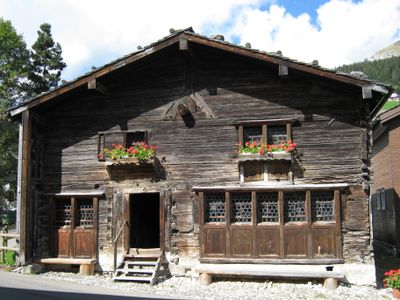
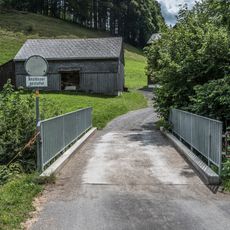
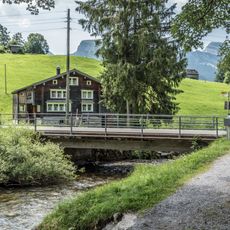
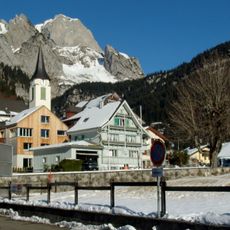
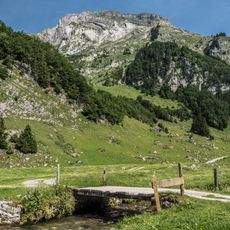
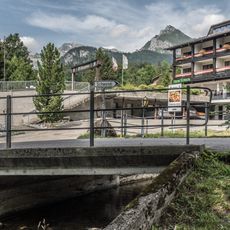
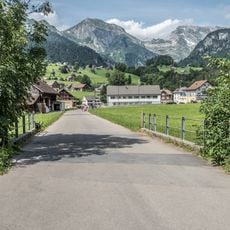
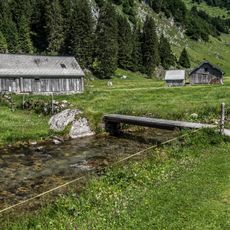
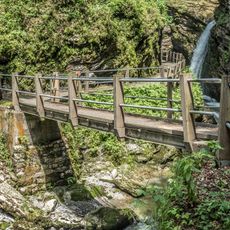
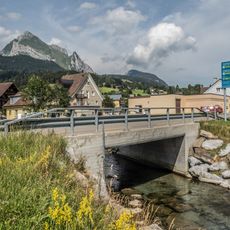
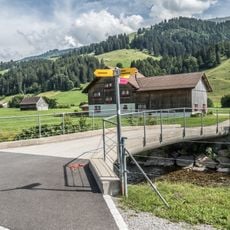
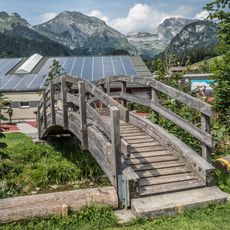
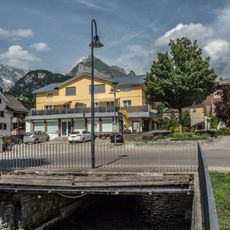
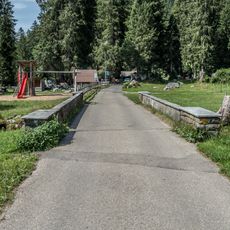
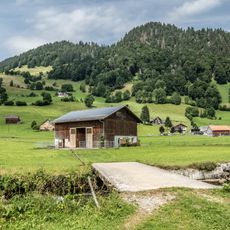
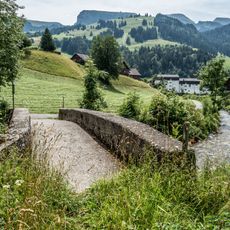
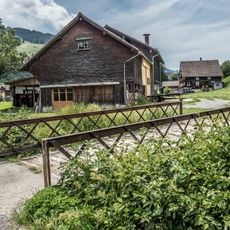
Zwingli house, Birth house and farmhouse in Wildhaus, Switzerland.
The Zwingli house is a Tätschhaus with a Schwardach: a shallow board-shingle roof weighted with stones and no iron nails. Its log walls are visible on the facade, and the gable posts form a so-called Heidenkreuz. The near-square ground plan has a Gothic-beamed Stube, a kitchen with a masonry hearth and large smoke hood, and a later side room; two sleeping chambers are reached by a Baroque staircase.
Neither the builder nor the date of construction is recorded; the house dates from the 15th century and Huldrych Zwingli was born there on 1 January 1484. From 1824 to 1842 it served as a schoolhouse. In 1848 the Zurich Zwingli Association bought it and gave it to the local reading society on condition that a Realschule be set up, opened on 1 May 1876. In 1897 it was renovated under cantonal architect Hermann Fietz, and in 1900 it was donated to the Reformed Church of Canton St. Gallen, which runs it as a museum.
The carved wooden ceiling beams in the main room show the craftsmanship valued during the Late Gothic period in this Alpine region. They reflect how prosperity and skill were expressed through home building practices among rural families.
Guided tours are arranged by the Reformed Church of Canton St. Gallen, which maintains the property and can help explain the rooms and their historical purposes. Informational materials are available on-site to provide context about the building and the family that lived here.
The room's oldest element is its Gothic beamed ceiling with central rosettes, a sign of the builder's higher status. The large clay stove in the Stube is a typical Toggenburg feature, and the kitchen's mortar-and-stone floor and small window hatch survive. A late-Gothic chest in the Stube comes from Trin in Graubünden.
The community of curious travelers
AroundUs brings together thousands of curated places, local tips, and hidden gems, enriched daily by 92,875 contributors worldwide.