Goetheanum, Anthroposophical center in Dornach, Switzerland
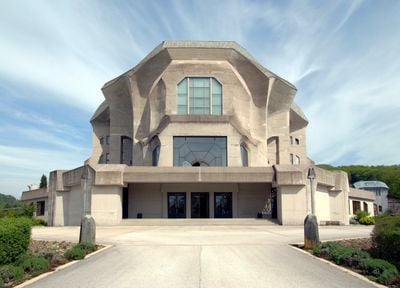
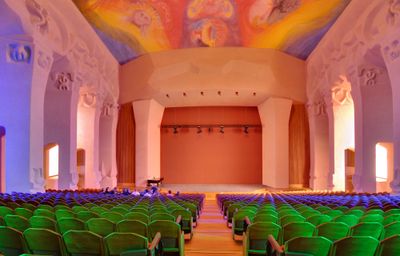
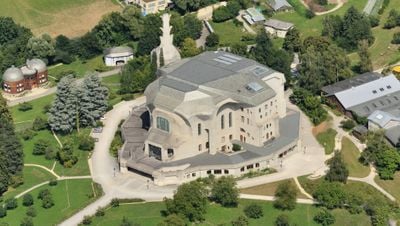
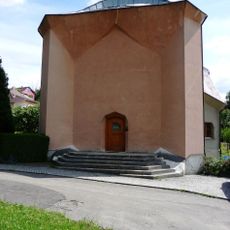
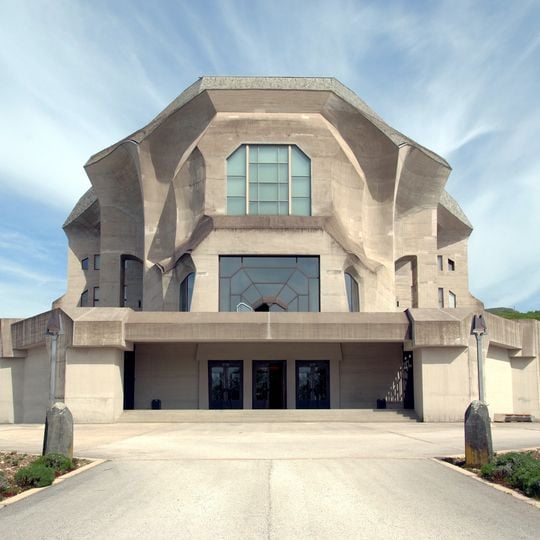
The Goetheanum is Rudolf Steiner's concrete building in Dornach, completed in 1928 and named after Johann Wolfgang von Goethe. Its sculpted facade has almost no right angles: a flat entrance canopy on thick piers, a large multi-paned window with angled top corners, and curved piers framing deep vertical openings up to a faceted roofline. Inside, the 1,000-seat auditorium has pale pinkish-grey concrete walls, a painted ceiling and green upholstered seats in wooden frames.
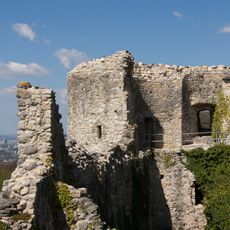
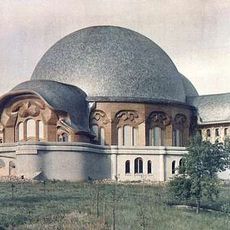
The first Goetheanum, a timber and concrete building with a double dome, opened in 1920 and burned down on New Year's Eve 1922/23. Rudolf Steiner designed a replacement in cast concrete, begun in 1924 and completed in 1928, after his death. The site in Dornach was chosen in 1913 after the Munich project failed; the hill was the battlefield of the 1499 Battle of Dornach.
The Goetheanum serves as the international headquarters of the Anthroposophical Society, welcoming visitors who participate in performances, exhibitions, and conferences centered on anthroposophical thought and human development. The building functions as a gathering place where art, education, and philosophical inquiry meet in daily practice.
The building offers guided tours daily, allowing visitors to learn about the architecture and the ideas behind it. It is advisable to allow adequate time for exploration and to check opening hours in advance, as the site is sometimes occupied by ongoing events and activities.
The nine-metre wooden sculpture The Representative of Humanity, carved by Edith Maryon and Rudolf Steiner, stands in a dedicated gallery. It was begun in 1915 and left unfinished at Steiner's death in 1925. The central figure is flanked by two opposing forms, one above and one below.
The community of curious travelers
AroundUs brings together thousands of curated places, local tips, and hidden gems, enriched daily by 92,606 contributors worldwide.