Prince-Bishops' Castle, Castle and Class A Swiss cultural property in Delémont, Switzerland.
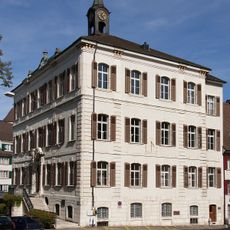
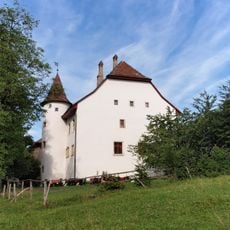
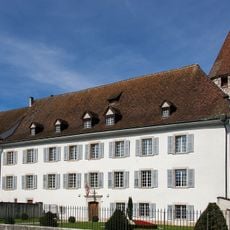
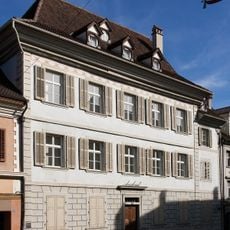
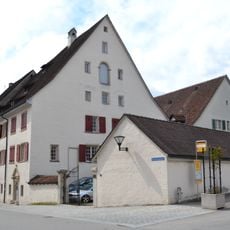
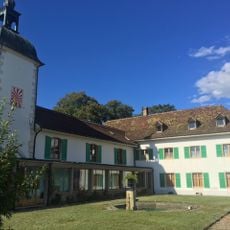
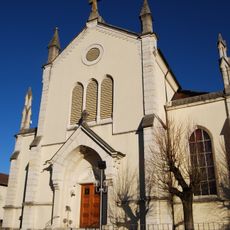
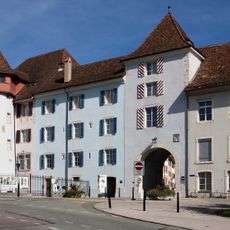
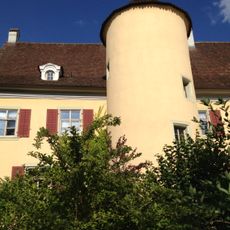
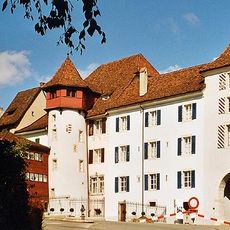
The Prince-Bishops' Castle is a large Baroque complex occupying the south-western quarter of Delémont's old town, not a hilltop castle. Built from 1716 to 1721 by architect Pierre Racine for prince-bishop Jean-Conrad de Reinach-Hirtzbach, it has a cour d'honneur closed by an 1787 wrought-iron gate, a monumental staircase, and a vast roof with dormers, chimneys and gargoyles. Its silhouette, beside that of Saint-Marcel church, is one of the town's symbols.
A medieval fortified house stood here by 1383. Prince-Bishop Jean-Conrad de Reinach-Hirtzbach had the present castle built from 3 October 1716 to 1721 to designs by architect Pierre Racine, as a summer residence without fortifications. In 1793 it was sold as national property; in 1821 the town of Delémont bought it, and in 1846 it became the seat of the college.
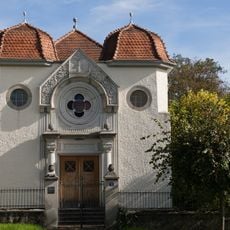
The name recalls the prince-bishops of Basel, who used the castle as a summer residence and administrative seat. The garden's west side housed the former orangery, which served as a synagogue from 1880 to 1909. Since 1908 the former barns and stables have been used as a gymnasium.
The castle occupies the south-western quarter of Delémont's old town, not a hill; access is from the rue du 23-Juin through the 1787 wrought-iron gate. Visitors may enter only the courtyard and the corridors, where the facades, the monumental staircase and the mansard roof with its gargoyles can be seen. The garden, laid out in eight squares around a central fountain, lies south of the building.
The castle's cellars held wine from the prince-bishop's vineyards in the Birse valley and at Ötlingen in southern Germany, while two granary levels under the roof stored the Delémont seigneurie's grain, hoisted by winches. The former orangery on the garden's west side served as a synagogue from 1880 to 1909.
The community of curious travelers
AroundUs brings together thousands of curated places, local tips, and hidden gems, enriched daily by 93,784 contributors worldwide.