Venus of Monruz, Paleolithic Venus figurine in Neuchâtel, Switzerland
The Venus of Monruz is an 18 mm tall pendant carved from black jet, a glossy lignite with fine pale speckles. It renders a stylized human body: a rounded hook-like top pierced by a single hole, a bulbous midsection swelling to the left, and a lower part tapering and curving to the right.
The Venus of Monruz was found in 1991 during rescue excavations ahead of the N5 highway construction at Monruz, a suburb of Neuchâtel. It belongs to the Magdalenian, dated to about 11,000 years ago, and is now held at the Laténium museum in Neuchâtel.
The figurine belongs to a group of female form representations that were common during the Magdalenian period. Such small objects may have been worn as pendants or used as ornaments.
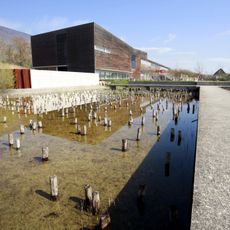
The Venus of Monruz is kept at the Laténium in Neuchâtel, the museum of archaeology of the canton. It is a pendant barely 18 mm tall, so ask for its display case and look closely at the drilled hole at the top.
The Venus of Monruz is made of jet, a black glossy material with pale speckles, and closely resembles the larger jet Venus from Engen found about 130 km away in Germany. The two may have been carved by the same artist or belong to one regional carving tradition.
The community of curious travelers
AroundUs brings together thousands of curated places, local tips, and hidden gems, enriched daily by 92,690 contributors worldwide.