Tarasp Castle, Medieval castle in Scuol, Switzerland.
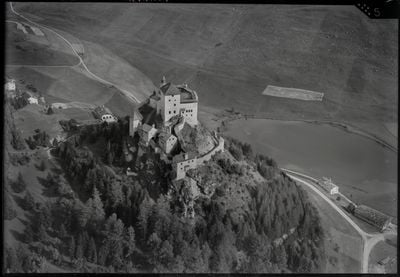
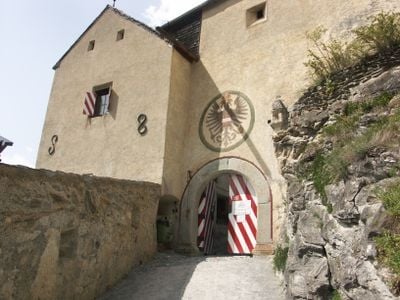
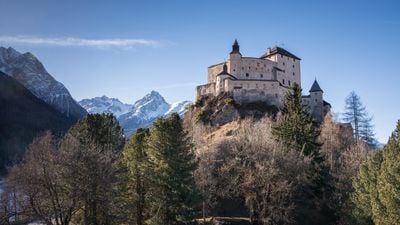
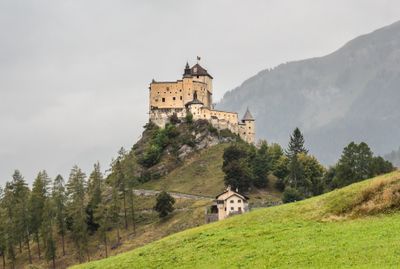
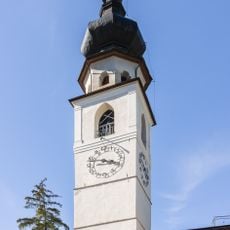
Tarasp Castle stands on a conical rock hill above the Inn, made up of an upper and a lower bailey. The upper bailey holds the core castle with south and north wings, covered wall walks and a cistern, grouped around an inner courtyard; the lower bailey, terrace-like to the north, holds the guard house, powder towers, gatehouse, chapel and a five-storey free-standing campanile with a Baroque onion dome. Pale plaster walls with dark stone at the base, steep dark roofs and a small corner tower rise above conifers.
The castle's core was built around 1040 by Count Ulrich I of Tarasp on a 100-metre rock hill above the Inn. The Tarasp line died out in 1177; the bishops of Chur had held rights since 1160, and from 1239 the castle passed to the counts of Tyrol. From 1273 the Matsch family held it as vassals, giving it much of its present form. In 1464 Ulrich IX von Matsch sold it to Sigmund of Austria; Protestant locals stormed and burned it in 1612, and lightning set it alight again in 1625.
The castle's name probably derives from Latin terra aspera, "wild earth", referring to the cleared land above the Inn. Its 1915/16 organ was built by the Jehmlich firm of Dresden; its pipes are distributed across several side rooms and sound reaches the festival hall through ducts and ornamental grilles. The three-manual console stands in an adjoining chamber.
The site is easily accessible by train to Scuol-Tarasp station followed by PostBus connections, with regular guided tours available. Most visitors should plan for about one hour to explore all the rooms and areas within the castle.
Swiss artist Not Vital purchased the castle in 2016 and now uses it as a platform for national and international art exhibitions. This transformation brought contemporary creative energy into the historic walls.
The community of curious travelers
AroundUs brings together thousands of curated places, local tips, and hidden gems, enriched daily by 92,655 contributors worldwide.