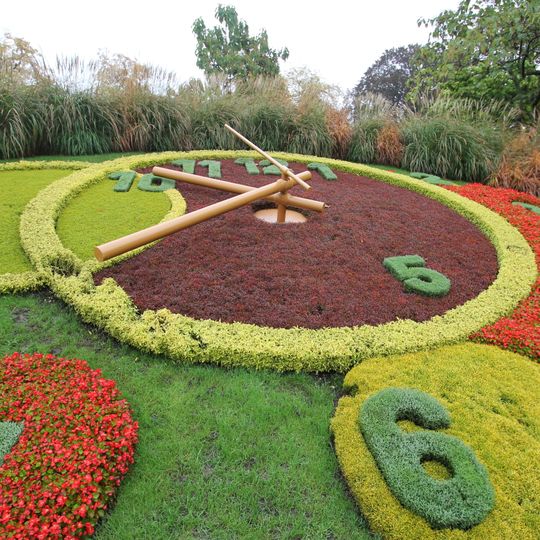
L'horloge fleurie, Floral clock at Jardin Anglais, Switzerland
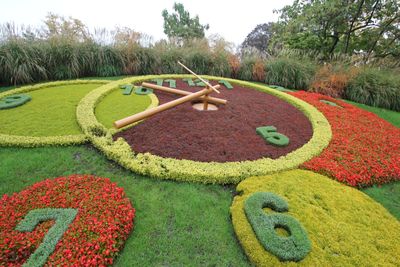
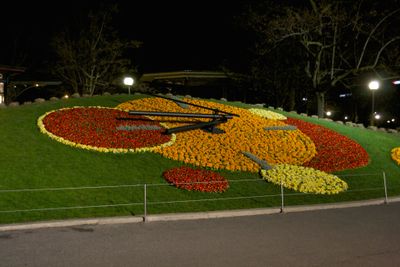
L'horloge fleurie is a flower clock on the western side of the Jardin Anglais in Geneva. Its circular face is planted with about 6,500 flowering plants and shrubs, changed with the seasons, and measures 5 metres across. The face is divided into 8 coloured sections, with numerals formed from plants and metal hands at the centre.
The floral clock was created in 1955 by landscape architect Armand Auberson for the city of Geneva. In 2002, painter Josée Pitteloud and sculptor Jean Stern modernised its design. It was the largest flower clock in the world, with a diameter of 5 metres, until a 15-metre clock was installed in Tehran in 2005.
The clock displays seasonal changes through its plantings: begonias in summer, pansies in autumn, primroses in March, and fresh pansies in April. These rotating compositions turn the garden into a place where visitors experience nature's rhythm throughout the year.
The clockwork is kept accurate through satellite synchronization and remains accessible year-round in the garden setting. The best time to visit is early morning or late afternoon, when fewer visitors are around and the plantings are seen in better light.
The second hand is 2.5 metres long, the longest in the world. The clock was the largest flower clock in the world, 5 metres across, until a 15-metre one was installed in Tehran in 2005. Its time is set by satellite.
The community of curious travelers
AroundUs brings together thousands of curated places, local tips, and hidden gems, enriched daily by 92,783 contributors worldwide.