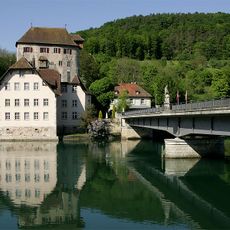
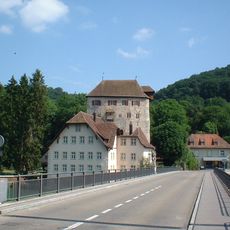
Rhine Bridge between Kaiserstuhl and Hohentengen, International road bridge connecting Kaiserstuhl, Switzerland and Hohentengen, Germany.
The Rhine Bridge between Kaiserstuhl and Hohentengen is a road bridge with a 1985 steel-composite deck: two continuous girders spanning 43.05 m each, a 2.0 m deep deck, and a reinforced concrete slab at least 32 cm thick. It carries two lanes (6.0 m total) and a 1.75 m pedestrian walkway, linking Germany's L161 with Switzerland's Hauptstrasse 7.
A wooden bridge stood at this narrow point of the Hochrhein in the Middle Ages; a 1294 document mentions the castle at Kaiserstuhl "ander brugge lit". A covered wooden bridge of 1769 was burned by the French in 1799, and the 1823 bridge by builder Blasius Balteschwiler was swept away by a flood in 1876. A two-span steel bridge followed in 1885–1891; its superstructure was replaced in 1985 by a steel-composite deck, after Baden-Württemberg and Aargau signed a state treaty on 23 February 1983.
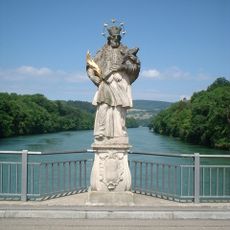
On the downstream side at mid-span stands a natural stone statue of Saint Nepomuk, the bridge patron, a copy of a 1752 sculpture by Kaiserstuhl carver Franz Ludwig Wind. The original stood on the earlier crossing, so the figure has watched over this narrow stretch of the Hochrhein for centuries.
The deck carries two lanes totalling 6.0 m and a single 1.75 m pedestrian walkway on one side, so walkers share the crossing with traffic. It links the German L161 on the right bank with the Swiss Hauptstrasse 7 on the left. A 1969 structural survey limited the old 1891 steel span to vehicles of at most 16 tonnes before it was replaced in 1985.
In the middle of the bridge, on the downstream side, stands a natural stone statue of Saint Nepomuk, the patron saint of bridges. It is a copy of a sculpture carved in 1752 by the Kaiserstuhl sculptor and woodcarver Franz Ludwig Wind.
The community of curious travelers
AroundUs brings together thousands of curated places, local tips, and hidden gems, enriched daily by 94,339 contributors worldwide.