Festungsgebiet Gotthard, Military fortification in Gotthard Pass, Switzerland
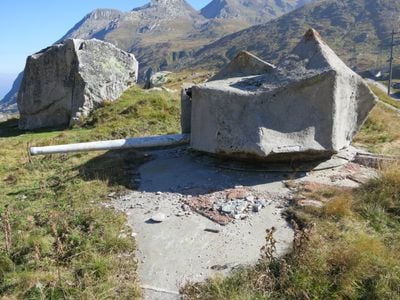
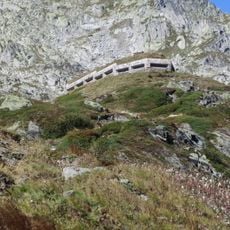
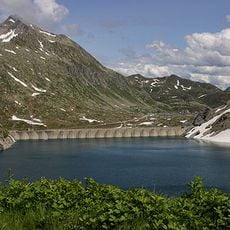
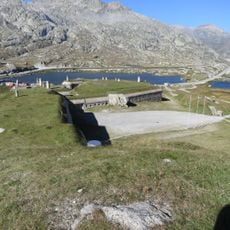
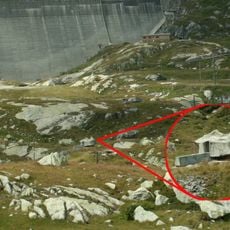
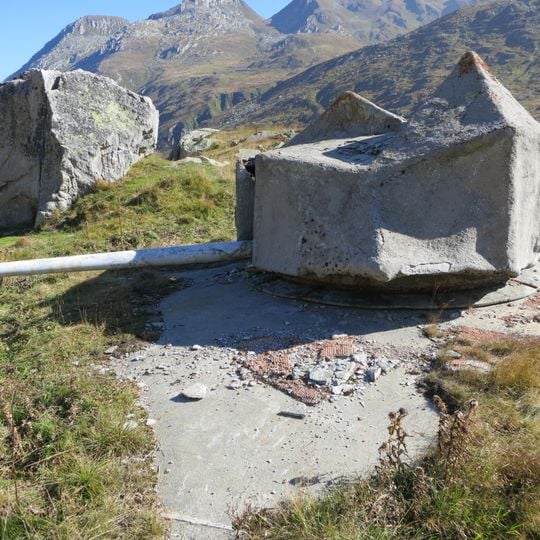
Festungsgebiet Gotthard is a Swiss Army fortress region spanning the cantons of Bern, Graubünden, Ticino, Uri and Valais, built to block the Gotthard axis and the passes into the Gotthard basin. Its works include Forte Airolo (1887–1890), Fort Motto Bartola above Airolo, Fort Hospiz on the pass summit, and the three artillery works Fort Stöckli, Fort Bäzberg and Fort Bühl forming the "citadel" of Andermatt. The photographed emplacement is a squat concrete block with a sharply sloped top and a protruding observation hood, its grey surfaces streaked and pitted, set on a foundation slab among broken red bricks, tile fragments and rubble, with a pale pipe entering one side and thin metal rails curving around the base.
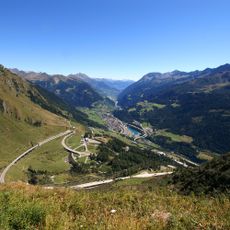
The first Gotthard fortress, Forte Airolo, was built between 1887 and 1890, five years after the railway tunnel opened, to guard the tunnel, the Gotthard road to the south and the road into Val Bedretto. In the 1890s Fort Motto Bartola above Airolo and Fort Hospiz on the pass summit followed, and by the end of the century the three artillery works Fort Stöckli, Fort Bäzberg and Fort Bühl formed the citadel of Andermatt. From 1935 to 1939 the army added the San Giacomo blockhouse, the Grandinagia artillery work and the Manegorio bunker in Val Bedretto, after Italy built a road over the San Giacomo pass 14 km from the tunnel's south portal.
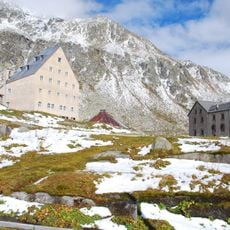
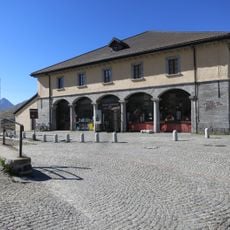
The name Gotthard comes from the Hospice of St. Gotthard on the pass, and the fortifications were built to guard the railway tunnel opened in 1882. The Festungswachtkorps maintained the works through the Cold War, and today former artillery positions such as Fort Hospiz and Forte Airolo can be visited.
The fortress is open for visits only during summer months from June to October when guided tours are available. Visitors can reach the fortress easily via the Postbus stop 'Gotthard, Passhöhe' and find free parking just a short walk from the entrance.
The fortress remained under military secrecy until recent years, with many of its functions unknown to the public for a long time. Only with changes in security policy were parts of the installation opened to visitors.
The community of curious travelers
AroundUs brings together thousands of curated places, local tips, and hidden gems, enriched daily by 94,117 contributors worldwide.