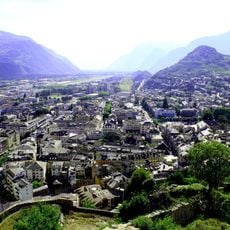
Le Petit-Chasseur, Prehistoric necropolis in Sion, Switzerland.
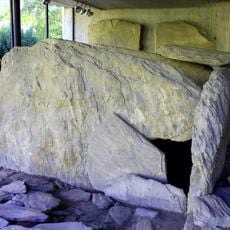
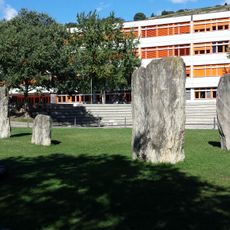
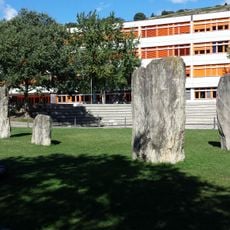
Le Petit-Chasseur is a prehistoric site in Sion whose occupation runs from the Middle Neolithic to the Roman era. Two dolmens with triangular bases are displayed in the St-Guérin district; most tombs were built from reshaped Neolithic funerary stelae, and the carved anthropomorphic stelae from the digs are now in the archaeology museum.
Workers laying a pipe in July 1961 uncovered two large cists made of engraved slabs. Professor Marc-Rodolphe Sauter first dated them to the early Middle Ages, but Bell Beaker pottery sherds pushed the dating back nearly three thousand years. Five excavation campaigns between 1962 and 2003 revealed occupation from the early Middle Neolithic to the end of La Tène, with the megalithic necropolis erected around 3000 BC.
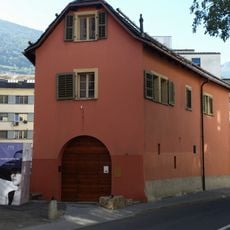
The carved stones are anthropomorphic stelae, and many tombs were built from older Neolithic funerary stelae that were recut for reuse. The finds, mainly these stelae, led to the opening of the archaeology museum in 1976 at the Grange-à-l'Évêque in Sion.
Two dolmens with triangular bases are displayed in the St-Guérin district of Sion, where you can see them in the open. The finds from the digs, mainly anthropomorphic stelae, are held at the archaeology museum opened in 1976 in the Grange-à-l'Évêque. The site lies within the city, so it is reached on foot from the centre.
The six stones found in 2019 lay in the same area as about 30 standing stones and the dolmens uncovered in 1960–1961, during construction work on a residential building. Several of the stones had been deliberately broken, and three carry carvings; the largest, roughly two tonnes, is read as a male figure in geometrically decorated clothes with a sun-like motif around the face.
The community of curious travelers
AroundUs brings together thousands of curated places, local tips, and hidden gems, enriched daily by 92,749 contributors worldwide.