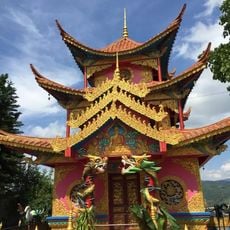
Jingzhen Octagonal Pavilion, Buddhist pavilion in Jingzhen Village, Xishuangbanna Dai Autonomous Prefecture, China.
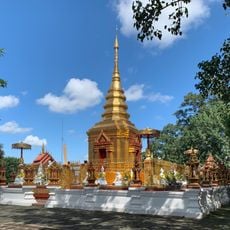
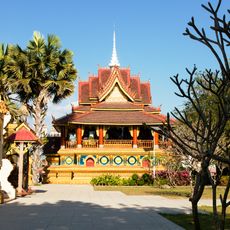
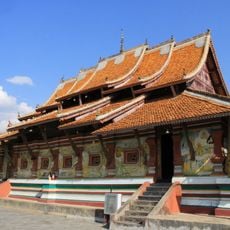
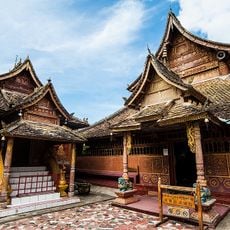
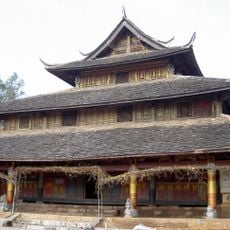
The Jingzhen Octagonal Pavilion is a Dai Buddhist ordination hall (uposatha) in Jingzhen Village, Menghai County, Yunnan. It stands 15.42 meters high and 8.6 meters wide, with a brick base and body in a folded "亞"-shaped plan, four doors, a circular wooden eave, and an eleven-tiered conical roof of eight groups of suspended gable roofs. The finial is a 4-meter iron rod inlaid with silver flowers.
Built in 1701, the year 1063 of the Dai calendar, the pavilion served as the ordination hall of Jingzhen Temple. The temple itself was destroyed in 1853 and only the hall survived. It was repaired in 1978 and 1993, and in 1988 the State Council listed it in the third batch of Major Historical and Cultural Sites Protected at the National Level.
The pavilion is the ordination hall (uposatha) of Jingzhen Buddhist Temple, built in 1701 in the Dai calendar year 1063. The rest of the temple was destroyed in 1853 and has since been rebuilt, leaving the hall as the original structure. Its name comes from Jingzhen Village in Mengzhe Township, Menghai County.
The pavilion stands in Jingzhen Village, Mengzhe Township, Menghai County, in southern Xishuangbanna. It is the surviving ordination hall of Jingzhen Buddhist temple, whose other buildings were rebuilt, so the brick base and body are the original 1701 fabric. Visitors should dress modestly and keep clear of any ordination or meditation in progress.
The sources give the pavilion's total height as 15.42 metres, made up of base, body, roof and finial; the finial itself is a 4-metre iron rod sheathed in silver floral ornament. The English Wikipedia adds that the pavilion was built in 1701 to quell an angry horde of wasps, and that it was repaired in 1978.
The community of curious travelers
AroundUs brings together thousands of curated places, local tips, and hidden gems, enriched daily by 92,783 contributors worldwide.