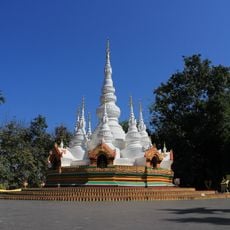
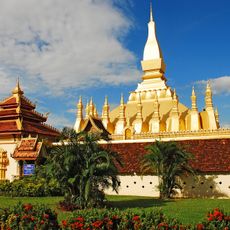
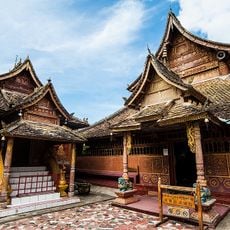
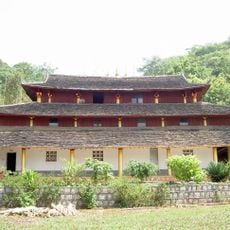
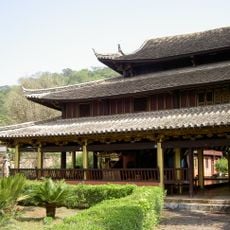
Zongfo Temple, Buddhist temple in Jinghong, China
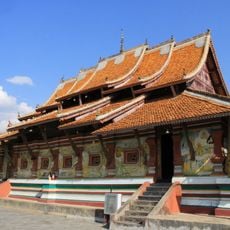
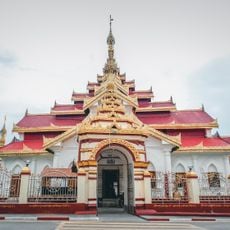
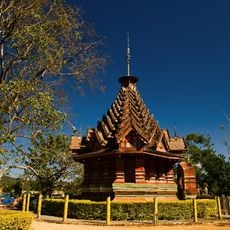
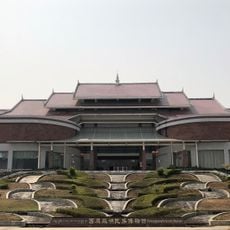
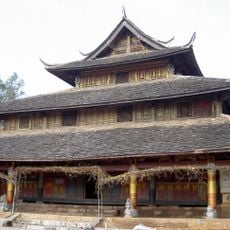
Zongfo Temple, on Baji Road in Jinghong, is a rectangular walled compound oriented southwest to northeast. Its two-storey main hall (Weihan) faces east: a concrete lower level carved with traditional patterns and a timber upper level with five bays by nine. Inside, a 5-metre bamboo Buddha woven in 2015 by Burmese monk Vimalabodhi stands on the ground floor.
According to local chronicles, the temple was founded in 615 by two monks from Burma, making it one of Xishuangbanna's earliest Theravada sites. By the 13th–14th centuries it was the region's highest-ranking monastery, where the supreme ruler and local chiefs took oaths. Destroyed during the Cultural Revolution, it was rebuilt in 1989–1990 and again in 2009–2012.
The Dai name Wabaji means "forest monastery like Jetavana", referring to the grove where the Buddha spent 25 rains retreats. Since 1998 the temple has held an annual bathing-the-Buddha New Year ceremony, which the prefecture added to its Dai New Year programme in 2003. In 1996 the temple founded the New Star band, whose 1997 album was the first of modern Dai-language songs.
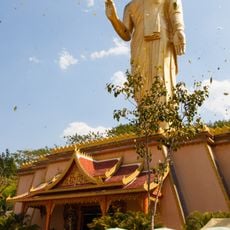
The temple lies on Baji Road near Manting Park, a rectangular walled compound facing northeast. The main south gate on Baji Road has three arched openings; the north gate is a decorative structure without a connecting wall. The main hall faces east, and the 7.9-metre standing Buddha stands on a platform below its front steps.
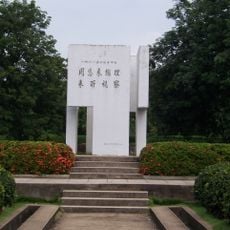
The temple's name was changed in 1990: Zhao Puchu, then president of the Buddhist Association of China, renamed Wabaji Temple "Xishuangbanna Zongfo Temple" and wrote the name himself. The plaque over the south gate shows Dai script above and his Chinese calligraphy below.
The community of curious travelers
AroundUs brings together thousands of curated places, local tips, and hidden gems, enriched daily by 93,469 contributors worldwide.